Blog

Looking back: How nostalgia gets it wrong

If you were a white, stereotypical, middle- or upper-class male, the past probably was lovely. But if you were female, non-white, an immigrant, LGBTQ, or just didn’t fit into your narrowly defined gender role, it was an oppressive time. It wasn’t until I heard Reverand Bill Sinkford speak at First Unitarian in Portland that someone articulated the problem with nostalgia.

What inspired this post? This article from The Independent by psychology professor Dr. Peter Gray. I agree whole heartedly with his research on the importance of play, but in the third paragraph, he writes,

“I’m lucky. I grew up in the United States in the 1950s, at the tail end of what the historian Howard Chudacoff refers to as the “golden age” of children’s free play. The need for child labour had declined greatly, decades earlier, and adults had not yet begun to take away the freedom that children had gained. We went to school, but it wasn’t the big deal it is today. School days were six hours long, but (in primary school) we had half-hour recesses in the morning and afternoon, and an hour at lunch. Teachers may or may not have watched us, from a distance, but if they did, they rarely intervened.”

I doubt that it was that simple, and I doubt that this was really true for a majority of kids. What about African-, Asian-, Latino-, Irish-, Jewish- or Native-Americans? What about poor white kids? Were they enjoying unprecedented free time after school where they could roam the streets safely? What about kids who were questioning their sexuality or who knew that they were different? What about girls who were told that their life goal was to find a husband and keep a house? How did they feel about being “lucky” in the 1950s?

This article from the Atlantic quotes These Happy Golden Years when a snow storm requires Laura Ingalls Wilder to get to work teaching school with no snow plows to make her own way, but she never thinks about canceling school or a 2-hour delay and even marks some kids tardy. Oh how wonderful life was back when people worked hard without complaint and kids respected their elders! Wendy McClure is quoted as saying, “You have to admit that the Little House books are constructed, and there were definite artistic decisions and efforts to portray things a certain way, and leave out other things.” This is the most important piece of this article: memories are inaccurate or incomplete.

Homecoming Sunday at First Unitarian Church was a profound turning point in my understanding of nostalgia. In his sermon on Sept 11, 2011, called Paradise Found, Reverend Bill Sinkford puts it succinctly,

“Now, nostalgia has its place. There’s merit in that vision and integrity in that lifestyle…. But looking backward to a lost eden can also be a retreat. A retreat from this world that can feel so difficult to understand and to navigate well, filled with so many obstacles to health and wholeness. This world can be unfair and even dangerous. It can be appealing, even seductive to wish the present away, and seek a return to a simpler way, a purer and more innocent time. A time before people of color and undocumented workers and their families became such a problem. A time when gender roles were clear and distinct. A time of abundance with the economy growing and jobs plentiful. A time of security and confidence in the future….

The main problem with yearning for [the ideal past], however, is not in the specifics. The main problem is that it encourages a rejection of this world here and now, with all of its beauty and possibility, as well as its problems. There is no encouragement to take responsibility for the way we live now and little incentive to help create heaven, here on Earth, in that vision.

… Eden never existed, of course. Or rather, it existed for only a small slice of our people. If you were poor or a person of color or queer the only place for you in that Eden was as a laborer, a servant or in the closet. Poor women and women of color always worked. And even if you were lucky enough to be middle class and white, the gender roles were constraining at best. There was unhappiness even in those households.”

We have different social, environmental, medical, and psychological problems today than they had sixty years ago, that’s for sure, and 60 years from now they will be different too. I would rather engage with the world as it is and let my vision of the future evolve, than escape into inaccurate and incomplete memories that belie a better time. It is here and now that I use my privilege to work for a better, fairer, more just world.

Beginning Courageous Conversations about Race, from Everyday Antiracism

At POCC, I picked up two books: White Like Me, by Tim Wise,
which I read cover to cover in the week following the conference,
and Everyday Antiracism, a collection of essays specifically for
teachers, edited by Mica Pollock. I’ve begun reading through the
essays and came to this one, Beginning Courageous Conversations
about Race. It has prompted me to finally write some of my
reflections about my experience at POCC. The four principles are
this: 1) Stay engaged. I think POCC more than any conference has
made me more reflective about who I am and who others are. I find
myself very aware of race and behaviors, constantly searching for
microaggressions and bringing it up in conversations with people,
almost probing to see if others are willing to talk about it. I
find myself seeking out people who have a more developed racial
identity so that I can listen to how they speak and what they
think. 2) Expect to experience discomfort. Oh yes. Falling silent
because you’re not sure how not to say the wrong thing? Yep.
Worrying that you’ve already said the wrong thing? Yep. I live in a
world where people mostly agree. And when we don’t, everyone is
very nice about it. When you begin to see terrible inequities and
racism in the fabric of your reality and it feels like you are the
only one seeing it, yes, you could say it’s uncomfortable, though
that’s a bit of an understatement. But even in my shifted world
view, I’m expected to carry on as though nothing’s changed, have
polite and thoughtful conversations, be nice about it, even when I
want everyone to be jumping up and down with urgency for the change
needed. At POCC, one of the best sessions I went to was about how
white children are racially socialized. I forget the prompting
statement, but a black man stood up and said something to the
effect of, “I’m tired of our kids having to suffer just so you
[white people] can keep figuring out how to cope with race!” This
really made an impression on me. It IS my responsibility NOW to be
racially competent. 3) Speak your truth. I have two thoughts on
this. I am grateful for the many people I have around me who are
always willing to engage with me. Second, I think I don’t always
recognize who is and who isn’t ready and able to. I tend to drop
small bombs in informal conversations with statements about how
uninclusive something is or the lack of diversity in children’s
books, for example. It might catch the other person off guard,
which is maybe why I do it, but I need to find more constructive
ways of engaging with others on this topic. 4) Expect and accept a
lack of closure. One of my beliefs that was shattered (in a good
way, though tough at the time) at POCC, is that the sheltered
environment of an independent school, where people are nice and
teachers are thoughtful and the harsh reality of the world is kept
away, is a good thing. Actually, it’s just a magnification of white
privilege. Yikes. I love the school I grew up at and the two
institutions at which I have taught, and never would I have thought
that what we were doing was actually worse than the real world!
Unpacking white privilege as it relates to independent schools is
an essential next step in my commitment to education and to who I
am as a person. I worry about sharing these thoughts publicly. In a
time when everything written can come back to haunt, I fear these
words will get taken out of context or that when I’ve gone further
down this journey, I’ll look back and judge my naïveté. But I will
be courageous and speak my truth and be gentle with myself, as I
would with others and hope they would with me. Thank you for
reading and being on this journey with me.

Goals and Resolutions

I just stumbled upon the “MS 2 Year Tech Plan” for 2012-2014 that I wrote two years ago. Apparently I internalized what I wrote down, because without looking at this for awhile, we’re making quite a bit of progress!

Major Goals:

1. Using the curriculum design, think through/evaluate new initiatives around programming & computational thinking and online/blended classroom environments – evaluating specifically amount of time expected for students, where resources are.

  • SimCity is well established in the 7th grade science curriculum
  • Minecraft is installed on all computers and kids have been using it in 6th humanities to sketch out their India buildings
  • Participation in Computer Science Education Week: I taught at least 45 minutes of coding to every single student and have carried on several lessons into 6th tech
  • Several teachers using flipped classroom models – mostly (to be honest) without any direct support from me

2. Parent partnership

  • Very well attended session on Instagram
  • Parent speed-geeking session that was well received
  • Upcoming session with a social media professional and another one on gaming

3. Personal

  • I’m continuing to blog and share – I was excited at how well my ICC Reflection was received by the committee
  • I’ve elaborated on the topics on my “Engaging Beyond” page
  • I updated my resume and wrote my personal statement
  • I’ve presented at two conferences and joined the executive committee for the ISTE Special Interest Group for Independent Schools
  • Supported teachers in fostering their own professional development, whether through encouraging presenting or developing their online presence through a portfolio or social media account
  • I took two MOOCs this fall, one on comic books and graphic novels and the other on video games and learning. I learned A LOT, shared a lot of the resources, and it fueled my energy for learning.

What we haven’t done:

  • Assessing what we already do through the lens of pre-production, production, post-production, publication
  • We still don’t have a curriculum design for technology pK-teachers
  • Students publishing online

Resolutions: What would I like to get done this spring?

  • Articulate the pK-teacher technology curriculum
  • More opportunities for teachers to see the value of Minecraft and integrate it into their curriculum
  • Curriculum opportunities for programming
  • Proposal for 8th grade rotation class in video game design, app design, social media, and 3D modeling

#PoCC13 – Getting Ready

 “Why did you want to come to PoCC?” Um, school initiative … mumble … intercultural competency … mumble mumble … A colleague told me it was the best conference she’d ever been to? I don’t know what I need to know? Maybe it is unnecessary to state this, but I am white. So why would I attend a People of Color Conference?

Continue reading “#PoCC13 – Getting Ready”

ICC Day 2

Culture Glasses

Yesterday was a professional development day. I was lucky enough to get in on the first round of “Day 2” of intercultural competency training. (I did Day 1 in August.) Our ICC committee has actually designed this curriculum for us with help from Janet Bennett from the Intercultural Communication Institute. It includes activities and topics specifically targeting what the school as a whole needs to work on. The workshops are facilitated mainly by teachers and involves all faculty and staff. The scope of this is what the implementation of real change looks like. Continue reading “ICC Day 2”

Schematic of Gamer Progression #videogamesandlearning @coursera

SchematicGamerProgression

I’m taking two classes through Coursera right now: Comic Books & Graphic Novels and Video Games & Learning. I’ve already read Persepolis and American Born Chinese for the comic book class. I’m really excited about supporting our 8th graders as they read Maus (and teachers as they teach it) this year and working with our art teacher on creating resources for teaching visual culture. Continue reading “Schematic of Gamer Progression #videogamesandlearning @coursera”

Would your students have been able to do your assignments 20 years ago?

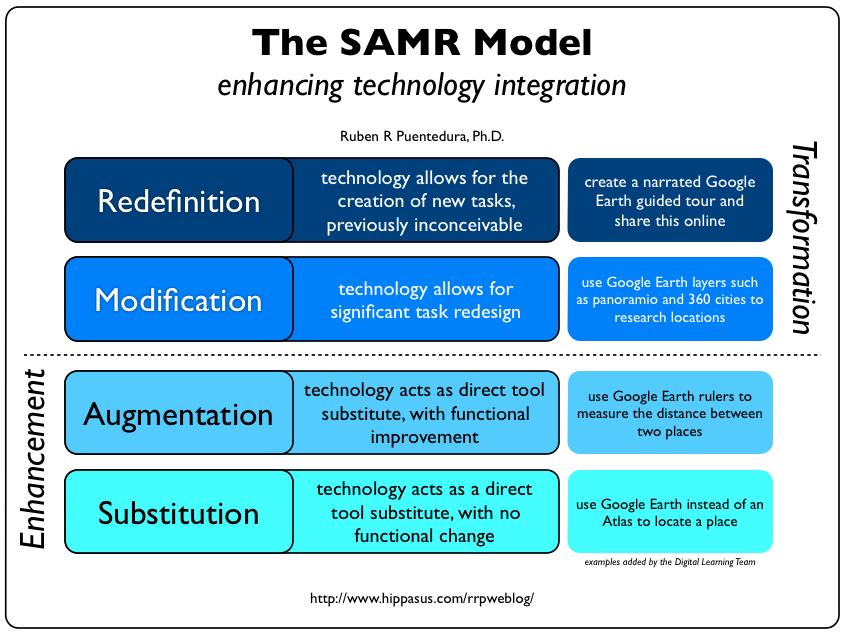
Ruben R Puentedura’s model for enhancing technology integration.

I’ve been thinking about innovation in education recently. Actually, I pretty much always thinking and reading about it. Yet somehow the SAMR model for technology integration had never come across my screen. I was scrolling through Feedly and up popped this blog post by Jeff Utecht about using iPads to replace textbooks. His point was essentially, “Really? That’s the best we can think of?”

It got me to thinking about where my teachers are on the continuum of integrating technology. Are their “projects” innovative or just tied with the shiny bow of new technology? Continue reading “Would your students have been able to do your assignments 20 years ago?”

Beginning Teaching in Outdoor Education (or, How I was Inspired to Teach)

This slideshow requires JavaScript.

When I graduated from college, I wanted as far away from academia as possible. I was tired, very tired, of memorization and tests that had sapped the joy out of learning. Now, I’m beginning my eighth year as a teacher, enthusiastic about learning, and am applying to graduate school.

College was an emotional and geographic roller coaster: I graduated from high school from the American School of Paris in June, split with dear friends, spent the summer working three jobs (including cleaning hotels rooms) in Door County, Wisconsin. In September, I plopped down at Washington University in St. Louis, and though I did well there, rowing crew and acing organic chemistry, I wasn’t happy. I spent the summer as a Girl Scout Camp Counselor near Minneapolis, the fall at the Biosphere 2 in Tucson, Arizona, studying astronomy, and the spring back in Paris at the Sorbonne. It was healing and grounding to have chosen to go back to Paris, a place I’d always felt conflicted about. At some point, I decided I didn’t want to return to St. Louis and applied to transfer to the University of Wisconsin – Madison. I spent the next two years there, starting in analytical chemistry, switching to biochemistry, and finally graduating in biology with a double major in French. While all my friends applied to medical schools, I had no idea what I wanted to do, so I moved out to Montana to work on a dude ranch.

Continue reading “Beginning Teaching in Outdoor Education (or, How I was Inspired to Teach)”