Blog

Book Notes & Thoughts: Inevitable, Mass Customized Learning

inevitable

They apparently couldn’t choose a title, so there are three:

Inevitable

Mass Customized Learning (MCL)

Learning in the Age of Empowerment

by Charles Schwahn & Beatric McGarvey

I’ll admit, I did more skimming on this one than usual as it is meant to be a vision to practice manual and I’m not actually working in a school right now. I’ve also been part of a research group studying personalized learning schools for the past year, which means I’ve heard and seen a lot of these stories. I think for teachers and leaders in traditional school settings, however, this could be a powerful book for reimagining what learning can look like. The authors do a nice job of pairing vignettes from multiple perspectives – students, teachers, parents, leaders – with specifics about support systems or assumptions that we make.

One of the most compelling and frustrating aspects of educational change is that “we all know these things. Yet, our behaviors do not support them.” (p.82) When you finally see the disconnect between the way we do school and the way we choose to do the rest of our lives, from shopping to listening to music to hanging out with friends, you can’t stop seeing it. Some people might challenge that school shouldn’t be the same as real life – it’s “work” after all, whatever that means. I was recently reading over an interview with one of the teachers in our study and she said that her former colleagues keep commenting how she looks so much more relaxed and happy this year. It seems we are all perpetuating a system that stresses us out (kids, parents, teachers, and leaders included) just because that’s the way it is and always has been? So much of what we do – one test for all kids, writing papers and getting feedback a week later, sitting in lectures – isn’t actually the best way to do it. If our purpose is to facilitate learning, if this is the function of schools, then the form of our schools needs to follow this (p.78). Capitalizing on the technology and resources that are already at our disposal means that it’s possible.

Continue reading “Book Notes & Thoughts: Inevitable, Mass Customized Learning”

Org Theory Reading Reflection 2: Teacher Turnover and Teacher Shortages

From https://thosewhoteach.files.wordpress.com/2013/11/blameteachers.jpg

This week’s assignment was to choose one article to summarize and analyze.

Ingersoll, R. M. (2001). Teacher Turnover and Teacher Shortages: An Organizational Analysis, American Educational Research Journal. 38(3): 499-534.

Having not yet taken Intro to Quantitative Methods, I still feel like I don’t quite grasp the full picture of articles like this because I don’t understand all the methods, but it helps that the article’s argument is clear and laid out logically from the literature review. Ingersoll articulates how his research is a departure from what has typically been done, which has been studies of the characteristics of teachers, versus a study from an organizational perspective. Essentially, he asks whether there are organizational conditions of schools associated with turnover. He uses data from the Schools and Staffing Survey (SASS) and the supplement, Teacher Followup Survey (TFS). Importantly, the TFS is a subset, those who had moved from or left their teaching jobs, were contacted after 12 months later to fill out a second questionnaire, along with a representative subset of teachers who stayed in their teaching jobs.

Some key findings:

  • Hiring difficulties were not primarily due to shortages in qualified teachers.
  • Demand for new teachers more often due to “preretirement turnover.”
  • School-to-school differences in turnover is significant: “Schools that do report difficulties in filling their openings are almost twice as likely to have above-average turnover rates” (p. 515)
  • Private schools have higher turnover rates than public schools.
  • Predictors of turnover, after controlling for teacher characteristics, are likely to be teachers under 30 or over 50.
  • In public schools, higher raters of turnover in high-poverty schools as compared to more affluent schools.

In particular, I liked the approach he took of distinguishing between “movers” and “leavers” because both have an impact on the schools they leave. I will say that quantitative articles always leave me hanging when they make interesting conclusions: but did you talk to any teachers? It feels like a first step in the study but an incomplete story in the process of understanding what is happening.

Continue reading “Org Theory Reading Reflection 2: Teacher Turnover and Teacher Shortages”

Org Theory Reading Reflection 1: Loose coupling of educational systems

Get it? Loose coupling...  From http://images.fineartamerica.com/images-medium-large-5/steam-locomotive-no-999-c-1893-daniel-hagerman.jpg
Get it? Loose coupling… From http://images.fineartamerica.com/images-medium-large-5/steam-locomotive-no-999-c-1893-daniel-hagerman.jpg

This summer I’m taking one class, Organizational Theory, and doing an independent reading credit with my advisor. My first writing assignment is already due tomorrow (summer classes go fast!). To be honest, it feels good to write for a class again and Org Theory is one of the classes I am most excited to take while I’m in graduate school. I know I know: #edugeek. And proud of it.

Educational Organizations as Loosely Coupled Systems, by Karl E. Weick.

Prior to the readings this week, I already associated the phrase “loose coupling” with Karl Weick, but had not read much about it. After the readings this week and last, I have a better idea both what is meant by it, its origins, and its application to the current state of public K-12 education. What I find most compelling is the way a term, meant to be descriptive of organizations, was taken up as negative and used to push remedies (as described in Firestone, 2015), perhaps without full consideration of whether it was actually a bad thing to begin with.

Weick, like organizational theorists before him, are attempting to describe what happens in organizations and predict outcomes based on actions. Rational descriptions and theories, predominant at the time, of how organizations function were incomplete and didn’t help people make sense of their experiences. The idea of “loose coupling” was meant to describe a mechanism by which we can understand “events that are responsive, but that each event also preserves its own identity and some evidence of its physical and logical separateness.” (p. 3) In other words, things happen that have a relation to each other, but it is not necessarily straightforward and logical in the way that can be rationalized. I see this as similar to thinking about multiple variables or systems thinking.

Educational organizations have a long track record of interventions or reforms that don’t go as planned. Loose coupling helps explain that, since we tend to plan with the assumption that what our intentions are going to have certain results, but if the elements are not rationally connected in reality, it doesn’t work.

It is easy to feel like loose coupling is a bad thing because it thwarts reform efforts. Nonetheless, Weick attempts to describe it in ways that are neutral or might actually be beneficial to the organization. He gives seven reasons why loose coupling might exist in an organization:

  1. “allows some portions of an organization to persist”
  2. “provide a sensitive sensing mechanism”
  3. “good system for localized adaptation”
  4. “retain a greater number of mutations and novel solutions than would be the case with a tightly coupled system”
  5. breakdowns are “sealed off” from the rest of the system
  6. “more room available for self-determination by the actors”
  7. “relatively inexpensive to run because it takes time and money to coordinate people”

To me, the most interesting of these is the benefit of localized adaptation. This allows teachers to adapt their instruction and the environment of their classroom to the needs of their individual students, but this has been much reduced with the movement towards standards and accountability. Firestone (2015) elaborates on this, describing the accountability movement as largely aimed at reducing the problems of loose coupling. I find it ironic that even as testing and sanctions have been applied to reduce the loose coupling, they themselves have not been as effective as hoped, as the policies were rationally designed and applied to a loosely coupled system, perhaps without full understanding of the system itself. To me, this leads to two conclusions: one, you have to focus on the people in the organization and how they learn, not just doing interventions to them, and two, you have to pay attention to context.

I think this is what I like so much about design-based research, in which feedback on the design is integral to the process, and what I like about the Networked Improvement Communities (Bryk, Gomez, Grunow, and LeMahieu, 2015), where feedback is gathered early and often, doing small testing in context and reducing variation in implementation by paying attention to what works when and where, rather than assuming something that is well designed will work. NICs also use root cause analyses to elucidate variables that contribute to the problem and then focus action on those variables and measure results. I can see now that this is essentially a strategy for improving interventions in a loosely coupled system. In some ways, you don’t have to know the mechanism for why the improvement works if you have measurements to show that it does and pay attention to context.

Also interesting is Weick’s sixth point that loose coupling may allow individual actors more self-determination, giving them autonomy and agency over their work, thereby a sense of professionalism and internal motivation. Again, Firestone’s article helps put this in relief, where this was good and bad: teachers want the autonomy but also feel isolated. Thus, teachers might want the movement towards “professional learning communities” or other programs that provide resources for collaboration and break down the silos of individual classrooms, but this comes along with threats to professionalism. Can you have both collaboration and individual agency? I think so, but perhaps not in the traditional school set up.

Firestone concludes that after 40 years of tightening the system, it isn’t working, except in exceptional cases. So my questions is then, is whether loose coupling, this idea that Weick wrote about 40 years ago, is actually helpful in the goals of educational research to understand organizations, predict how they will react, and thus shape them? Meyer and Rowan (1977) go into more depth why systems decouple as a result of the conflict between categorical rules and efficiency: “Thus, decoupling enables organizations to maintain standardized, legitimating, formal structures while their activities vary in response to practical considerations.” (p.357) Maybe loose coupling allows us insight into why things are the way they are, but is the theoretical construct of loose coupling really valuable if the practical considerations ultimately have more control over what actually happens?


Byrk, A., Gomez, L., Grunow, A., LeMahieu, P. (2015). Learning to Improve: How America’s Schools Can Get Better at Getting Better. Harvard Education Publishing.

Firestone, W. (2015). Loose coupling: The “condition” and its solutions? Journal of Organizational Theory in Education. 1(1).

Meyer, J. Rowan, B. (1977). Institutionalized Organizations: Formal Structure as Myth and Ceremony. American Journal of Sociology. 83(2): 340-363.

Weick, K. (1976). Educational Organizations as Loosely Coupled Systems. Administrative Science Quarterly, 21(1): 1-19.


GLS11 – Reflections

Screen Shot 2015-07-10 at 3.20.42 PM

I FINALLY made it to the Games+Learning+Society Conference! I heard about it probably 4 or 5 years ago and it was always held right at the end of the school year. GLS was a big reason that I wanted to come to Madison to graduate school.

My takeaways:

  • I love the people and the ideas and discussions they have. Game designers, academics, teachers, and lots who bridge all three communities. That said, games are not a core piece of my research, so I was able to do the “slow conference” thing: not rushing to every session, picking sessions at the last minute, not furiously taking notes to remember everything that was said.
  • My reading list just got longer. First, Seymour Papert’s Connected Family. Also, Ready Player One by Ernest Cline (on audiobook narrated by Wil Wheaton???). And maybe, The Game Believes in You, by Greg Toppo.
  • Definitely a thread running through the conference about whether schools are the answer or the problem. Clearly some have given up on schools as a place to create change, which is disheartening. (Someone said: “[It’s] such a pain to get technology in the classroom.”) My question to them: If you don’t think schools, then who? You? The game design companies? Maybe schools aren’t universally where we want them to be, and goodness knows change is hard, but I still think they are a critical player (pun intended) worth paying attention to in making society better.
  • The keynotes were great – Sean Dikkers on Tuesday, Nichole Pinkard on Wednesday, and Brenda Romero on Thursday:
    • Seann‘s presentation reminded me that I really need to start crafting my personal story that translates the importance and drive of my professional work. The most compelling talks always seem to come through these personal stories (“When I was a kid…”). I also need to dig out some good (read: embarrassing) pictures of me as a kid.
    • Nichole spoke about her work with YouMedia in Chicago. As I’ve become more interested in the Cities of Learning initiatives, it was exciting to hear her take on using informal learning spaces to create pathways for learning across content and sites. She proposed three questions:
      – How do we follow the opportunities, follow the kids, and try to connect them?
      – How do we understand organizations and how they connect? Because kids can only go to things that exist.
      – How do we know what kids are doing, particularly in out of school time? Digital badges?
    • Brenda was funny, serious, and real. She talked about being a game designer and being a woman. The most interesting part, though, was sitting behind three white guys clearly uncomfortable with how to react or process the (sometimes) rant, particularly when she mentioned breastfeeding, pregnancy, or reproductive parts. There were eye rolls and sideways glances to each other while they read their email and surfed the web.

Screen Shot 2015-07-10 at 3.47.53 PMScreen Shot 2015-07-10 at 3.47.40 PM

Continue reading “GLS11 – Reflections”

Book Notes & Thoughts: Communities of Practice, Part II

CoP_Design

Part II took me a lot longer to read than the reading schedule I had laid out for myself in June. I got bogged down reading the epilogue and life just kept getting in the way!

Wenger uses great examples to illustrate his concepts throughout, whether from his vignettes about the claims processors or everyday life, but the final chapter on education really brought everything together for me with the concepts coalescing around a concrete application. When you view legacy schools through this lens, it is clear how they are lacking possibilities for mutual engagement, material to support imagination, and participatory alignment. (p.183) In contrast, I see many positive connections with the personalized learning environments I have observed in Wisconsin, places where students define their trajectories, explore their identities, and participate in a communities of learning. “Indeed, the mutuality of engagement is a mutuality of learning.” (p.277)

What I liked about the identity component of communities of practice (CoP) is that it explains a lot of my observations and gives them a coherent nature. For example, I worked at a school where my work spanned multiple communities: the middle school teacher, the technology department, the boarding program, and sometimes all-school committees. I could feel my behavior shift in each situation, everything from how I participated in meetings to how I dressed. I negotiated a multimembership identity (and loved it) and brokered many conversations across these communities. (p.255) I could see too how I carried ideas from one to the other, where the technology department meetings almost served as an innovation zone where we shared what happened in other divisions and brought those back to ours. “Boundaries are inevitable and useful. They define a texture for engaged identities, not vague identities that float at the level of an abstract, unfathomable organization.” (p.254)
Continue reading “Book Notes & Thoughts: Communities of Practice, Part II”

Book Notes & Thoughts: Communities of Practice, Part I

Communities of Practice: Learning, Meaning, and Identity, by Etienne Wenger

At the end of my first two semesters in graduate school, I think I know just enough now to know that I do not know what I want to study or how I want to study it. I am still interested in networks, leadership, and change, but do not know the level at which I want to resolve those ideas, much less how I would study it. Much of the work I want to do this summer and fall is searching for a conceptual frame that helps me describe my observations in a way that moves understanding (mine and research generally) forward. I’m beginning this here with Communities of Practice.

Reading this was slow, especially coming off of the three previous books I’ve written about (Connected, Where Good Ideas Come From, and Disrupting Class), which were popular nonfiction, written to be engaging to a general audience. Communities of Practice is definitely aimed for an academic audience, and “presents a theory of learning that starts with this assumption: engagement in social practice is the fundamental process by which we learn and so become who we are.” This assumption is not how I have previously conceived learning. I think it is pretty typical in a Western, individualist society to think of learning as something individuals do, with teaching as something we do to others, not as something created between us. Continue reading “Book Notes & Thoughts: Communities of Practice, Part I”

Book Notes & Thoughts: Disrupting Class

Book cover, from Amazon.com

By Clayton Christensen, Michael B. Horn, and Curtis W. Johnson

*note that these authors are not educators

Do not read this book, but if you do, please only read chapters 2-5. The authors’ do give a compelling argument for the way disruptive innovation happens, and there are certainly some good ideas for how to approach changing the educational system in there. Outside of that, see my comments below.

The authors propose using an innovation lens to study the problems in education, which are identified as problems by the international test scores that say the United States is behind other countries in math scores (TIMSS) and in the number of STEM graduate students and the changing demographics of Silicon Valley. (p.6) To their disparaging point about the “changing demographics”: from what I have read, it is still predominantly white men. A company like Google is still 70% male and 60% white, but I get it: it’s not 100% white men like the good ol’ days. Also, assuming the “diversity” comes from outside of the United States is not accurate and perpetuates stereotypes. That is not to say that some of the non-white and white people in Silicon Valley are not foreign nationals, but as our country continues to diversify, the workforce and management should as well. I realize that this is not the thrust of this book, but the cultural, racial, and gender bias in the way this book is written made me want to throw it against the wall repeatedly.

Downward trend in students that study math & engineering because the extrinsic motivation is gone when a country becomes prosperous (p.7-9)

“Assigning schools new jobs for which they were not built – and therefore not necessarily doing – has mean that schools don’t look as good in light of the new requirements.” (p. 45) I agree. I find it ironic that on page 156, in the chapter about the effect of early child development on academic success, the authors suggest that high schools should be tasked with teaching parenting skills to improve how they speak to their children in the first 3 years of their lives because that it the root cause of the achievement gap. Does that sound as contradictory to you as it does to me?

Schools are improving, but those improvements are not valued because of 2 disruptions: Nation at Risk, NCLB

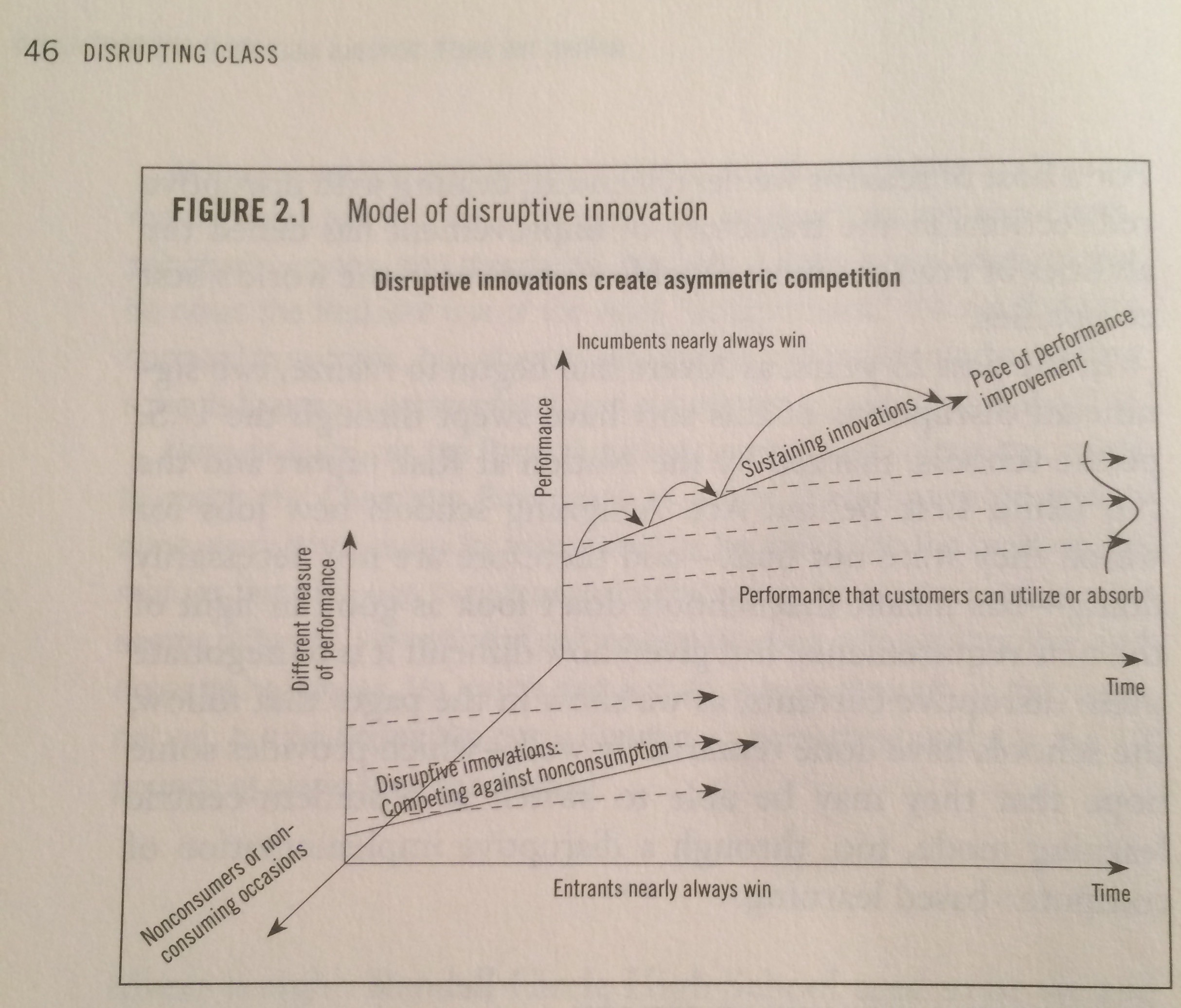
p.45 disruptive innovation theory

p.46 key diagram of disruption
FullSizeRender

p.47 disruptive innovation is not equal to breakthrough improvement: it benefits nonconsumers – those unable to use the standard

p.55 “crisis in education” 1958 Life Magazine cover because of Sputnik

History of Education p.64

Job 1: preserve democracy and inculcate values

Job 2: provide something for every student (turn of 20th century – competition with Germany)

Job 3: keep America competitive (Nation At Risk)

Job 4: eliminate poverty (NCLB)

p.73 “schools have crammed [computers] into classrooms to sustain and marginally improve the way they already teach and run their schools, just as most organizations do when they attempt to implement innovations, including computers.” Thus the failure of a lot of 1:1 programs where students never use them or only use them for non-school activities.

p.74 “To succeed, disruptive technologies must be applied to applications where the alternative is nothing”

p.75 “organizations will shape every disruptive innovation into  sustaining innovation because organizations cannot naturally disrupt themselves”

p.81-82 computers serve to sustain the school model rather than disrupting

p.92-94 places with non consumption – ripe for disruptive technologies

  1. rural & urban high schools that lack funding or qualified teachers and online can offer AP or other options
  2. homebound/homeschool students
  3. credit recovery

p.102 pressures on schools

  1. technological improvements make learning more engaging
  2. design of student-centric software
  3. looming teacher shortage
  4. cost pressures

p.105 future classrooms – not the best but maybe the best possible

p.107 increased student:teacher ratio – I’m not a fan and it doesn’t seem to be what is working in PL

p.110 no more summative assessment with online learning because integrated into the learning process – only reason we need summative assessments is because we don’t know how students are doing during the learning process

p.135-6 second phase of disruption will be people assembling together to teach each other – custom-configured to each different type of learner – no mention of participatory cultures? connected learning?

p.136-7 all this stuff about tutors as the platform – no mention of Blooms 2sigma problem/research

p.140 having to teach material is when you finally understand it – this was definitely true for me with a lot of the biology I had to teach in my first year in the classroom

Teachers unions are almost always used as the example of barriers to change in the system, though on p.141 they do acknowledge that there are many factors, such as textbook adoption process and demand for standardization. I think they should also add elected officials who defund education and unfunded mandates that hamstring districts.

p.143 “Introducing student-centric learning through facilitated networks” – Who will build these networks? How will people get paid to create content? Earlier examples of facilitated networks included telecommunications or banking – “the network is a supporting infrastructure that helps the buyers and sellers make money elsewhere” and “participation in the network typically isn’t the primary profit engine for participants.”

p.147 Vignette about Principal Allston. It’s hard to take these as serious from three male writers: “Sitting in her office, flush from vindication of having given Maria the Arabic class she’d wanted, Stephanie Allston gets up, closes the door, kicks her heels off, and puts her nylon-clad feet up for just a moment.” Really?

p.155 It is really hard to read this writing about poor “young, single, inner-city mothers” and the previous section on how this lack of “dancing talk” is the cause of multigenerational entrapment: “the children of lower-income, poorly educated, inner-city parents are trapped in a multigenerational cycle of educational underachievement and poverty.” (p.153) While this might play a part, it is not the only piece of the poverty puzzle. What draws me to a networked approach to solving problems is that there is never one cause and one solution. It is always more complicated than that. Also, “welfare families”? How old is this research!?! Hart & Risley (began research in 1965) and a reference to lenababy.com, which conveniently sells software, hardware, and courses to improve the language exposure during childhood to “close the achievement gap.” Hmmm… I smell a white upper class rat.

p.156 “Professional couples…often are so anxious to get back to their careers after childbirth that they hand their babies prematurely to caregivers whose responsibilities for multiple children give them bandwidth for little more than business talk.” I’m pretty sure it’s not exclusively because of being anxious for their careers. Let’s remember that the United States often has NO paid parental leave for either moms or dads, and when there is, it’s sometimes as little as 2 weeks or at most 6 weeks. Aside from paid leave, the cost of childcare is more than college tuition in some places. Slamming parents for not making better decisions ignores the principles of their own book about understanding the decisions that customers make rather than making assumptions. And while we’re at it, maybe instead of yet another suggestion for schools to fix the problem through some home economics classes, which we know is really directed at the girls, not the boys, and which we know won’t actually work, as this whole book as been trying to point out, how about we focus on affordable health care that pays for prenatal visits and delivery in a hospital; quality, affordable childcare for whenever parents choose or need to go back to work; and a little less ignorant judgement on the part of the authors.

p.160 I thought finally they were going to talk about participatory cultures and connected learning! Nope.

p.174-5 In an interesting juxtaposition, the authors cite the Big Picture schools, which use project based learning and student teams, held up as a model for “integrated” experiences, then computer-based learning, which is about delivering content in a competency-based, self-paced, continuously assessed way. Big Picture, to me, feels very relationship and interpersonal based, whereas the computer-based learning seems much more individualistic, both person and content-wise. Also, I wonder how the Big Picture schools would stand up in a double blind, “gold standard” study?

p.223 “Districts should see chartered schools as heavyweight research and development laboratories whose charter, in essence, is to help the district match a school typology with students in a given circumstance.” I’m continually disappointed by the failure of the authors to address issues of equity and access. The idea of classifying students according to some schema, which they mention as multiple intelligences repeatedly thorough the book, smacks of tracking and/or the other many ways that discrimination happens. I’m not ready to commit to multiple intelligences as a way to sort children. It’s just not that simple.

p.224 “Rather than view [chartered schools, such as KIPP] as competitors that are to be isolated, district schools need to monitor the success of chartered schools so that they can define the circumstance for which each different architecture is the superior solution.” Well, maybe the chartered schools could share some of their data and/or access to understanding their school? Also, let’s not assume they are successful before we have evidence, shall we? Particularly in this chapter, I’m surprised they haven’t brought up New Orleans at all. My understanding there is that it’s now all charter schools there and students basically apply to which one they think will work best for their child rather than having a neighborhood school. I’ve also heard that it isn’t working out well, particularly for students with special education needs.

p.224 “Viewing chartered and pilot schools – mostly aimed at reaching the underserved segment of the market…” Are they though? My recollection of the New Orleans charters says that they’re not serving special education students well. Can you site something that gives evidence that charters are about underserved populations? What exactly do you mean by “underserved”? Is this by low socioeconomic status? race? English-speaking? special education?

p.230 diagram of tools of governance that can elicit cooperation

FullSizeRender 2

p.235 The authors suggest that we have reached a point with schools where democracy will not work for change, so, as illustrated by the Chattanooga Schools, “mayors have taken direct control of their schools districts” and “appoint[ed] a superintendent who shared their same vision, and the superintendent did not have to worry about pleasing disparate school board members who have competing visions for reform…. [I]n many ways, many of the structures of democracy no longer stand in the way.” This concerns me on two levels. First, the replacement of a public, democratic, educational system, once called the foundation of our society, by benevolent non-educator dictators? Second, I believe in a sort of fractal like alignment in culture for the different levels of education. If we want to live in a democracy, students need to learn to participate in civic life, to vote, to be engaged in community, and one way is for them to learn this is in schools. If we want teachers to teach this, they need to participate in a democratic organization so that their voices are heard, that they have representatives in governance. I don’t think we can reorganize schools from in an autocratic way from top down, ignoring the voices of teachers who are meant to carry out this work with students, and then expect them to cultivate a love of learning and civic engagement in their students.

Just one page later, the authors write, “Although better learning is the goal, states and districts cannot ‘enact’ better learning. All they can do is create the conditions that motivate teachers and students to do whatever it takes to get better results.” (p.236) Oh really? So now we should pay attention to teacher motivation?

“They haven’t made soccer practice virtual yet, but even that might be useful.” (p.242) Um, I’m pretty sure it’s called Fifa 15 on XBOX One.

They do not develop the modularity idea. They describe is as opposed to interdependent, where interdependent means that all the parts are dependent on each other, rather than something like a Dell computer which could be built of components bought from different sources. What would this look like in education? Is it just about having a clearer system of credits or badges that indicate which standards are mastered?

Their final recommendations to graduate schools of education includes “circumstance-based statements that will help us make much better progress in the years ahead as we learn what each individual student needs, not what works on average for students in a school” (p.248), yet they cite randomized controlled trials or double blind studies as “a significant step forward” (p.196) in their section on education research. They qualify this that this is the first step in their descriptive phase of the research pyramid that they propose, and that RCT should be a starting point to then investigate the anomalies, underlying conditions, or circumstances that affect those that respond or do not respond. I wish they could have given some examples here. I think I might need to read Meredith Honig’s book that they cite about education policy. Something I think they are missing, however, is that the methods for how you understand circumstances are not possible, in my growing understandings of how these things work, through RCT. You need qualitative researchers who do research from constructivist, post-modernist, and critical approaches. The questions asked by researchers in those paradigms allow us to understand people and learning.

As you can tell by my comments, I have a lot of objections to how this book is written and what is written in the book. What scares me is that this is stuff people outside of education really like: praise on the back book jacket includes Jeb Bush (presidential candidate), Joel Klein (Chancellor NYC DoE), and Jim Collins (business leadership writer). There is certainly wisdom to be learned from outside of education, and I will definitely take away from this book the ideas of targeting non-consumers and disruptive innovation, but I would hope my writing would never come across so insensitive nor so dismissive of an entire field of work that I do not even work in.

Continue reading “Book Notes & Thoughts: Disrupting Class”

Book Notes & Thoughts: Where Good Ideas Come From

PhaseDiagram
From http://www.cliffsnotes.com/sciences/chemistry/chemistry/states-of-matter/phase-diagrams

I’m not sure what is more geeky: my favorite chemistry graph itself or the fact that I have one. But seriously, the phase diagram is so elegant! In one picture, it explains how temperature and pressure relate to the states of matter. The lines are phase transitions (like condensation, sublimation, and solidification), interesting edges for investigation to understand how the particles behave.

What does this have to do with my reading? Steven Johnson, in his book Where Good Ideas Come From, draws from many examples of innovation across history and across disciplines, many of which are from science, but in particular he uses the analogy of “liquid networks.” In a liquid, there is enough structure for particles to mix and combine but enough energy for them to move around and slide past each other whereas in a solid they would just be stuck in place and in a gas they would collide and fly away. In his analogy, the particles in a liquid social network are ideas and people.

Continue reading “Book Notes & Thoughts: Where Good Ideas Come From”

Reflections on “Blueprint for Armageddon”, WWI podcast series by Dan Carlin @hardcorehistory

Blueprint-for-Armageddon-1-500px1
Podcast “cover” artwork for the first episode.

Over the past three weeks, I’ve been listening to Dan Carlin’s Hardcore History podcast series entitled “Blueprint for Armageddon.” With six episodes and over 22 hours total, it was a major undertaking. And I don’t didn’t even like history! Like a good story teller does, he pulls you in and weaves a tale that you want to listen to, almost regardless of the content. But in the process, I became fascinated with the war itself, the technological changes, and the process of trying to imagine what it was like on the ground and what it was like to be alive and in the world at that time.

I think like most Americans who experience the normal high school curriculum, my experience with learning World War I was  in March/April of my sophomore year, at which point we highlighted enough major details (trench warfare, Wilson’s 14 points, Entente vs. Allies) in order to understand the seeds of World War II. We would move on quickly to World War II, which ran into the last weeks of the year and the cold war/60s/70s/80s were oh-by-the-way mentioned. You get the distinct message that WWI just isn’t worth focusing on, but in this (extensive) telling of the story, I was amazed at how, on many fronts other than just military history like the development of technology and social movements, this war set up not just WWII but an entire era that affects our beliefs today. Continue reading “Reflections on “Blueprint for Armageddon”, WWI podcast series by Dan Carlin @hardcorehistory”

Book Notes & Thoughts: Connected

Connected: How your friends’ friends’ friends affect everything you feel, think, and do, by Nicholas A. Christakis and James H. Fowler.

My summer reading list is quite long… I hope I’ll get to read and blog all of them, so here we are, starting strong, with the first one: Connected. As per usual, this is not a formal essay on the book but rather some quotes I thought were interesting and my reflections on reading.

  1. Networks as a “superorganism.” (p.xvi) This makes sense to me. The properties of the network that are emergent. They don’t exist in the individuals but exist only in the relationships of the parts. This book is a study of the structure and function of human networks. What’s the point? If we understand this, we can use a networked approach to understand and solve problems. This is hopefully where my doctoral research is heading within the context of education.
  2. Network diagrams are really beautiful pictures (p.12), but it’s quite hard to determine their shape. Yet determining the shape is important because we affect it and it affects us. Mobile technologies and interesting websites (like wheresgeorge.com) give interesting insights, but it’s never complete. Yet somehow I feel like this is the size of the ruler and coastline paradox. Networks are infinitely complex, so what’s actually important is knowing how you bring it into focus. I’ve thought some about open and closed networks this year with my Carnegie reading and summit, and that’s one of the things I continue to find interesting. Open networks allow space for innovation but closed networks give you the feedback you need to understand your participation.
  3. “Social networks, it turns out, tend to magnify whatever they are seeded with.” (p. 31) Hmmm… this sounds very powerful and very scary.
  4. There are several interesting chapters about characterizing the shape of networks through tracking diseases and money, among other things. I was most interested when they began talking about networking creativity. (p.162) In an analysis of Broadway musicals that succeed or fail, researcher Uzzi (1996) concludes that teams who had never worked together failed because they were not well enough connected but teams where everyone had worked together also failed, presumably because there were no interesting ideas. Ultimately, he concluded that there was a sweet spot with diversity of new people and stability of previous relationships. This has significant implications for how one might about assembling a team of people to work on a project together.
  5. Possibly my favorite chapter was “It’s in Our Nature” with the biologist in me coming out. I find fascinating the idea that we have evolved a society where there is a balance between the number of cooperators, free loaders, and punishers. Robert Axelrod’s study of a cooperative strategy, where you cooperate the first time, see what people do, and then copy what they do after that (i.e. if they don’t cooperate, you won’t cooperate again, but if they do cooperate, you will again). This might be a mechanism by which humans tested out a strategy and then evolved cooperative societies or doomed them to not survive. The punishers enforce social norms for people who try to free load on the system. All these roles together, Hauert and his colleagues showed, would produce the conditions where you have a mixture of these three types of people that was always in flux. Maybe I should have been a sociologist, except that I always want to know how we apply this information. I think it comes down to understanding that there are different roles in a network. As the authors say, “some people will be well connected to the social network, and others – the loners – will not.” (p.221) So how you focus networked action must be based on the roles of the players in the network, the level of resolution you want to see, and structure of the network at that level.
  6. The Hyperconnected chapter is not that new anymore. As I was reading, this chapter could have been in a number of other books. What I did pick up here, though, is something that goes along with It’s Complicated, by danah boyd (which I wrote about here). It’s not that people are different today, but our new technologies have new affordances, and these affordances change what the behavior looks like, but not necessarily the motivators or biological drives. Another piece that I would argue is that the authors over-idealize the ability to assume an avatar and have it treated as just the avatar. I don’t remember and can’t find the source (so if you know it, please add in the comments) of where I read this, but the text that you type is gendered, from the structure of sentences, the frequency with which you agree with the other person, the way you frame questions or statements, the vocabulary choice: all of that is gendered and cultural. There is less distinction between you and your online avatar than I think they make it sound.
  7. The last chapter, The Whole is Great, gets as the good stuff, getting back to the human superorganism and what we do with all this information and understanding. Social networks do not belong to people – they are properties in between us – and we can share these as a resource for public good. Public goods are available to all and not diminished by people’s use, but they are difficult to start and maintain, mostly because it’s hard to get people to pay for them. Of course, the authors point out, not all networks produce good things, with obvious examples like drug or sex trafficking. The point that I took away here is that they need to be considered both as a factor and a resource. In education, this might be as simple as recognizing that the teachers are connected to each other, and this network will mediate whatever efforts are made to maintain or change schools. It also means that taking a networked approach is more than just “networking,” where you get a lot of people’s business cards at an event. Networked actions work with or build the structure and function of the social network, something that is already built into our lives. I find this approach hopeful, in that doing good work can be spread through a network and can positively affect friends’ friends’ friends.