Blog

The World Really is Changing

I couldn’t resist FINALLY a reason to link to one of the best West Wing scenes:
“Nothing is where you think it is.”
“Yeah, but you can’t do that, because it’s freaking me out.”

This week’s reading:

Guy Standing – excerpt about the Precariat from Eurozine. Entire PDF here.
Diana Hess – chapter from More Controversy in the Classroom.
Beth Simone Noveck – chapter from Wiki Government.

Two notes: 1) I love that I can just link to the book on Amazon and not have to type out the APA citation. 2) I just discovered the paste text toggle off feature and it will save me from having to type

into the code to format my documents, which I write in Evernote then transfer. #smallvictories

This is my last course reading reflection of the semester. Hooray! If you haven’t already read my wikipedia page that I wrote for the class (although at this point it is a mixture of my writing + copy edits by another wikipedian), then you should check it out at https://en.wikipedia.org/wiki/Distributed_Leadership

The Future of School Leadership

I get caught in between wanting to believe the world is radically changed, which is why schools need to change, and wanting to believe that things are the way they’ve always been. Standing and Noveck, this week, both made me feel like the world is radically changed.

Standing’s article about the precariat made me wonder how much education responds to the changes going on socially in the world. Clearly teachers all live in society, so they experience it and are part of it, but the process of educating kids can feel so insulated (in a bad way) from the world. (I think Dewey said something like this.) I would see new teachers as fitting into the “proficians” category, in the sense that I don’t think most young teachers look at going into teaching as a life-long career. It is something they are interested in and will do for awhile until other interesting opportunities come along. I think this would also mean they lack a “work-based identity,” and learning the craft of teaching is not seen as a lifelong endeavor in the same way that it was for my parents.

Standing ends with a brief mention of commodification, “a central aspect of globalization…[that] has been extended to every aspect of life,” including the education system. By this, Standing means “everything can be bought and sold, subject to market forces, prices set by demand/supply, without effective ‘agency’ (a capacity to resist).” How does this work for information? It seems that the expectation for information is for it to be free, of which many examples are seen in Noveck’s chapter excerpt from Wiki Government. It made me think about Open Educational Resources, where people share a commodity for free.

Noveck mentioned Delver, the network based search engine. Unfortunately it does not appear to have continued to be funded, but thanks to the internet archive (archive.org), I got to see a video of their CEO, Liad Agmon, explaining it. Maybe it was before its time because people still do not see their social network as something they could mine for helpful connections.

I like the idea of every piece of information as a potential community, where data is seen in relationship to the groups who use it. This reminded me of our early discussions of data creating a Discourse (Gee). “By making information more visual, we make it easier to understand” (Noveck, p.127). This made me think of some of the work I did collaboratively with our art teacher around visual culture. Most of us know when we see a graphic we understand but we often don’t know why we understand it. Take a look at how terrible most research posters are. Clearly they do not follow a functionally transparent model of making sense! Who researches and teaches about the properties of how visual displays communicate? Artists.

The world is a dramatically different place than when our schools were founded, and yet schools still look very much the same. How much are we, as educational leaders, really willing to change? We read about double loop learning (Argyris) where single loop was feedback on what we did but double loop was how we did what we did. Maybe we need triple loop that puts how we did what we did in contemporary context.

Finally, a quick story came to mind after reading Hess’ article about discussions of controversial ideas in the classroom as a foundation of our democracy. One of my strongest and earliest teaching memories was a spontaneous debate with my first class class of 6th graders. We were discussing hunting as a way to manage wildlife populations. After they had all shared their views and counterpoints, they kept asking me what I thought. Instead of telling them, I asked them what they thought I thought. They started debating what they though I thought! I never told them my views, and I remember a sense of victory that I facilitated the discussion in a way that I could push from both sides while letting their voices be primary. When they walked out of class, they were still questioning the right answer, rather than putting the thinking away with my opinion.

Continue reading “The World Really is Changing”

Reaction: Leading Safe & Effective Schools

Three articles this week:

Schacter, R. (2010). Discipline Gets the Boot, District Administration.
Witkow & Fuligni (2010). In-School Versus Out-of-School Friendships and Academic Achievement Among an Ethnically Diverse Sample of Adolescents, Journal of Research on Adolescence. 20(3), 631-650.

Ratner, Chiodo, Covintgton, Sokol, Ager, Delaney-Black. (2006). Violence Exposure, IQ, Academic Performance, and Children’s Perception of Safety: Evidence of Protective Effects, Merrill-Palmer Quarterly. 52(2): 264-287.

The thread for me this week was a sense of being overwhelmed at all the other factors that shape who students are before they ever walk into a classroom. We spend so much time and money developing and prescribing curriculum that never considers the factors of school discipline policies, violence in the community, parenting, or friendships. As Warren wrote last week,  “it is patently unreasonable to expect that [urban schools] alone can compensate for the effects of poverty and racism.” The basic requirement for safety in schools was also looked at in Bryk et al. (2010) Organizing Schools for Improvement that we read at the beginning of the semester. It left me with a feeling of amazement that anyone who is not middle class and white makes it through the educational system at all. Witkow and Fulgini (2010) and Ratner, Chiodo, Covington, Sokol, Ager, and Delaney-Black (2006) do give ways that children cope, whether through friendships or protection, the latter of which might come from a caring teacher at school, but they are still outside of any curriculum.

Continue reading “Reaction: Leading Safe & Effective Schools”

Wikipedia… or, Handing Over “My” Work to the Wisdom of the Crowd

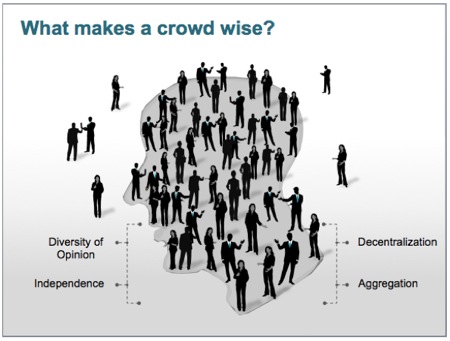
Linked from http://www.mewisemagic.net/wp-content/uploads/2014/03/Wisdom-of-Crowds-PowerPoint-presentation-editable-crowdsourcing-slides-editable-people-graphics-for-PPT.jpg

There are two weeks left of the semester. I took four classes this spring, so the end means lots of proposals and papers and group projects. One of my projects, as I wrote about previously, was to write an entry for Wikipedia. I chose to do “Distributed Leadership” because it didn’t exist yet and it’s a body of research that I wanted to get more familiar with for the work that I hope to do for my PhD. I moved it to main space last Friday. Here is a link: https://en.wikipedia.org/wiki/Distributed_Leadership

The technical parts of Wikipedia were not daunting: click here, talk pages here, write drafts in the sandbox, click there, upload pictures to wikimedia commons first, make sure not to violate copyright, keep notes on changes. Easy enough.

The objective of the assignment was straightforward: Read all the research and summarize from a neutral point of view. This is quite different from past assignments, where you are meant to make a statement, be critical in reviewing prior research, and present a well supported argument why your statement makes more sense.

I learned a lot (and am still learning) through this process, so here are Wikipedia’s 10 Simple Rules and my reflections on writing my article: Continue reading “Wikipedia… or, Handing Over “My” Work to the Wisdom of the Crowd”

Reaction Paper: Arts Education

I like this visual, though it needs to be updated to a five petal flower with digital media arts! Linked from https://mheprimaryinnovationstudio.files.wordpress.com/2013/07/the-arts1.jpg?w=604

Articles:

Halverson, E., & Sheridan, K. (2014). Arts Education and the Learning Sciences. Chapter 31 in Learning Sciences. (p.626-646).

Halverson, E., Lowenhaupt, R., & Kalaitzidis, T. (under review). Towards a Theory of Distributed Instruction in Creative Arts Education. Journal of Technology and Teacher Education.

Arts educators and researchers seem to spend a lot of time justifying themselves and their work, trying to demystify what it is and its value. Halverson and Sheridan (2014) note that the “inability to objectively assess arts production is what has destined the arts to remain peripheral in schools” (p.638). Many teachers and administrators are unlikely to have experienced a strong arts program in their own education nor do they have training in this area. How many art teachers go on to become principals? Even those who believe in it may not know how to go about implementation. Personally, I know that I never identified as someone who “got” art class: I could never discern the rules of the game. For this reason, what I appreciated most about Halverson and Sheridan’s (2014) chapter regarding arts education and the learning sciences was that it made each component clear and understandable. I think there is still a leap to how instruction would be designed and assessed, but that is where Halverson, Lowenhaupt, and Kalaitzidis (under review) pick up.

The idea of distributed instruction definitely resonates with my experiences. As a science teacher, I mentored all my students through the science research process every year. I would act as both instructional designer, setting up deadlines and templates, and content mentor, answering questions, delivering mini-lectures, or recommending further resources on everything from wind turbine shape to bacteria incubation to oscillating chemical reactions. I felt like my varied science background was a resource, and I loved getting to learn with the students about all these different areas. The process was exhilarating and exhausting. Once I became technology coordinator, one of my favorite things to do was go into the science classes and serve only as mentor, engaging with students about their projects without worrying about how they were meeting requirements. I see a lot of potential for the idea of distributed instructional design, particularly in the personalized learning model as as way to understand what happens in practice and what that practice reveals about the designer’s conceptual model of teaching and learning.

Finally, I was thinking back to our early discussion about Discourses (Gee, 2001) with its relationship to identity, and thinking about conversations with leaders of schools that are adopting a personalizing learning model. Like the kids in art class who “get it”, it seems like some teachers seem to just “get it”: they co-teach and flex as needed in order to orchestrate student-centered inquiry all without formal training as to how to do this. These skills are increasingly seen as valuable and scarce, so if we want to shift both teachers and students into this way of thinking about learning, we need a way forward, a way that arts based education already knows. In particular, arts education addresses identity and culture, which is crucial through the lens of Discourses. Furthermore, Gee (2001) writes, “one crucial question we can always ask about identities of any type is this: What institution or institutions, or which group or groups of people, work to construct and sustain a given Discourse?” (p.111) We have different “institutions” within our buildings fighting to construct and sustain Discourses, with literacy and STEM currently in charge and arts at the periphery. I see the articulation of arts based education and distributed instruction as leading the way for how to prepare teachers needed for these alternative, in-school environments, rather than perpetuating the myth of the teacher or learners that just “get it.”

Reaction Paper: Teachers, Policy, CCSS, and NCLB Critique

Linked from http://img.jillkonrath.com/hs-fs/hub/110248/file-16488225-gif/images/blogs/are-you-making-these-serious-sales-assumptions-06-20-2012.gif

The readings this week were fascinating. I feel like the article on Teachers and education policy: Roles and models, by Croll, Abbott, Broadfoot, Osborn, and Pollard (1994) was illuminating in terms of helping me identify my own subconscious beliefs about policy and practice. I think I’ve always felt like policy gets written and then watered down all the way through to where it changes very little of daily practice, but never considered that one was explicitly antagonistic to the other. I conceptualized policy makers and teachers as completely separate, both the people who do it and then ways of doing it, though ideally they would be informed by each other. Furthermore, it seems to me that the “discretionary action by professionals” is part of the system, so it is the job of policy makers to design policies that afford the right outcomes rather than expecting practitioners to figure out what was intended. Figuring out my own assumptions first allowed me to process the other possible models but left me wondering how others intuitively see it.

Speaking of policies and implementation, I found the Gates Foundation Report, Primary Sources: America’s Teachers on Teaching in an Era of Change (2014) to be vapid. There was no demographic data collected about the teachers, though I suppose it can be assumed that they were predominantly white. The upshot of the report is that they have found that teachers who are engaged like the CCSS and think it will help their students. I think teachers will report positively simply because they are working and putting effort into them. They would probably do this with any curriculum in front of them. Also, the one line of questions that are specifically about the common core all seemed to be phrased positively, like, “Please tell us your opinion on how each of the following has changed, if at all, as a result of implementing the CCSS” such as “Students’ ability to read and comprehend informational texts”. It seemed to me, though I am clearly not a survey expert, that there was a positive bias in the questions themselves. Overall it just felt like Common Core propaganda.

Finally, the NCLB critique by Cochran-Smith and Lytle (2006) was compelling and resonated, again, with subconscious and unexamined assumptions. In particular, I am surprised at myself that I never saw the flawed assumptions of teaching as a transmission activity in the NCLB model because it seems so obvious after reading it. This also made me question my research stance a bit, wondering if a more constructivist or constructionist approach might be more appropriate for studying dynamic learning environments. I will say that I am a proponent of alternative certification programs and myself did not have pedagogical training before I started teaching. I learned what I know now through mentorship and a Master’s program while teaching. Right or wrong, I felt prepared to teach in a classroom and was glad for the opportunity to do it right away rather than having to pay for further schooling. If I had had to get a degree after my Bachelors before getting into the classroom, I would never have become a teacher. There are also valid critiques of our own teacher education program and whether they are staying current on the current skills needed by teachers. Alternative certifications allow schools to get good people in the door and train them the way they want them to teach.

Design, Learning, and Data, Oh my! … (or how not to make people be defensive)

Readings this week:

Argyris, C. (1991). Teaching Smart People How to Learn. Harvard Business Review, (May-June).
City, E., Elmore, R., Fiarman, S., & Teitel, L. (2009). Chapters 4-6. In Instructional rounds in education: A network approach to improving teaching and learning (pp. 83-131). Cambridge, Mass.: Harvard Education Press.
Lieberman, A. (2000). Networks as Learning Communities: Shaping the Future of Teacher Development. Journal of Teacher Education, 221-227.

Design projects and data are not familiar language to educators, even though (hopefully most) teachers are literally engaged in design every day as they modify the local learning environment to fit the needs of their students. We rarely see it as such, though, as the emphasis is on students and their work in relation to the teacher’s design, not the reflection on our own thinking. This mirrors Argyris’ single-loop vs. double-loop learning. As Argyris notes, he was working with people who were “well-educated, high-powered, high commitment professionals,” which I think would describe a lot of graduate students in education. Argyris (1991) writes, “People can be taught how to recognize the reasoning they use when they design and implement their actions.” When faced with a design project that tests our thinking, where the likelihood of failure is high, fear creeps in.

It is through the very act of design, feedback, and failure that requires us to bypass our own interpretations because we’ve literally put our thinking outside of our heads. This act of dissociation of our emotional, judgmental selves from our practice is exactly what City et al. (2009) refer to as separating the practice from the person. Likewise feedback systems, whether they be user testing in design or observational notes in the classrooms, are what bring in the feedback, or data, on our design. When we can use the feedback to redesign, rather than defend, we can learn.

As we have heard in many readings this semester and again this week, professional community stems from “conversations about their work” (Lieberman, 2000), but clearly these conversations need data about practice, not about teachers, and the people conversing need guidance in using the data. City et al. (2009) refer to the “culture of nice” as an improvement-impeding norm, because it clouds the distinction between practice from person. People are unwilling to offer feedback for fear that it will be taken as criticism and elicit defensiveness, so they just avoid the conversation all together. The Instructional Rounds protocols offer such guidance for school leaders on how they help teachers in “learning to see, unlearning to judge” and offer clear expectations for how to discuss practice in a way that pushes people to think rather than defend.

On a more practical note, for the field work we are just beginning for the DRP class and on personalization in practice, I found many things helpful in the Instructional Rounds piece. At least for me, it will help me orient myself to conducting an observation: keeping it descriptive rather than evaluative, asking open questions to kids, not discussing with fellow researchers in the hallways but waiting for a time to debrief, and examining my own assumptions or biases about what good teaching and learning looks like.

Carnegie Summit Learning + Reaction 6

Screen Shot 2015-06-04 at 4.11.06 PM

If you had asked me about standardized tests 5 years ago, I would have vehemently dismissed them as the wrong direction for education. While I still resist the Fitbit model of constant quantification of progress and self, this week I heard and read about compelling ways that data can be used to build professional cultures, see and support individuals, and the design of better systems.

One of the sessions at the Carnegie Summit that I attended was a panel on Doctoral programs that embed improvement science into their curriculum, including the program at UCLA with Dr. Louis Gomez, whom we heard from a few weeks ago. He said two things that struck me. First, in working on problems the same way, you build organizational culture. This is echoed in Halverson (2010) “Over time, teacher concerns about teacher evaluation seemed to ease as the principal made a significant time commitment to help teachers make sense of the MAP data reports in terms of math instruction. The Walker principal used MAP data in faculty and staff meetings to create a common vocabulary for Walker teachers to discuss student learning.” (p. 141) To me, this is what data can do for schools when it is approached from a mindset of possibility rather than fear. Further, I heard more than one person at the conference remark that using data was allowing their teachers to have conversations about instruction never possible before. As Halverson quotes of the Malcolm school leaders, “The beauty of data is that we can have these conversations” (p.144). Second, Dr. Gomez stated that improvement leadership is social justice leadership, precisely because it builds common culture focused on improvement for all kids. It changes the system to yield better outcomes rather than treating the symptoms of a system that doesn’t work.

Continue reading “Carnegie Summit Learning + Reaction 6”

Pre-conference Reflections (or would that be PROflections?)

Let the learning begin!

Here I am at the Carnegie Summit. What am I hoping to learn and come away with?

This reflection ends up just being more questions. This started last fall when I read the paper on Networked Improvement Communities, and it felt like it was a roadmap to how I want to work with educational systems. So I’ve come to the conference to learn more about it, hear what people are doing and what they’re thinking about, and find out how I can maybe get involved.

If I had to pick a content interest that I have read about and am interested in it would be the development of a strong teacher workforce, and how districts can use a framework like that to reflect on where they are focusing their resources to drive innovation. But in my role as a researcher, how can I work with districts and the improvement science model? What do improvement scientists need from researchers?

One specific aspect I want to understand are examples of measurement that practitioners are using other than test scores and aside from post-measures like retention rate or success rate. What can I measure in real time?

Sessions I’m looking forward to:
Pursuing Excellence: An In-Depth Study of the School District of Menomenee Falls
Preparing the Next Generation of Leaders as Improvers and Stewards of the Profession
A Powerful Engine for Change: Applying the Model for Improvement
From Aim to Action: Developing a Theory of Practice Improvement

My first Wikipedia edits!

For one of my classes this semester, we are writing a wikipedia page. Although I’ve read about how Wikipedia works, I’ve never actually done this. Very excited to learn how to contribute.

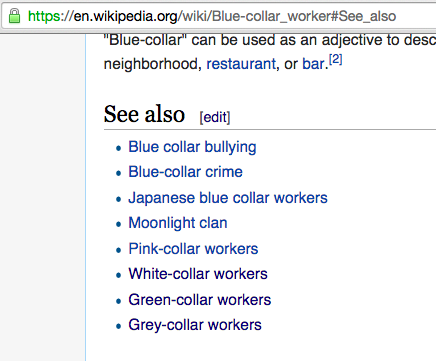
Turns out, it’s pretty simple. While in a class yesterday, I was looking up different labels for types of jobs, blue-, white-, and pink-collar, and found out that there is also green- and grey-collar jobs. On wikipedia, however, some link to each other but not to all. This seemed like a perfect first step!

I started with the blue-collar page, went down to the “see also” section, and added some links. Toute simple.

My first Wikipedia edit

I got excited and started searching through how to add content. I found a video that I’d taken while in Florida this January from our trip to the Everglades. So I uploaded it to the Wikimedia Commons and put it on the American Alligator page.

Actually, I accidentally put it on the American CROCODILE page, and as I was blogging it, realized my mistake. I learned how to find how to UNDO a change!