Blog

Reaction 5: Accountability, Educational Research Methods, and Inquiry

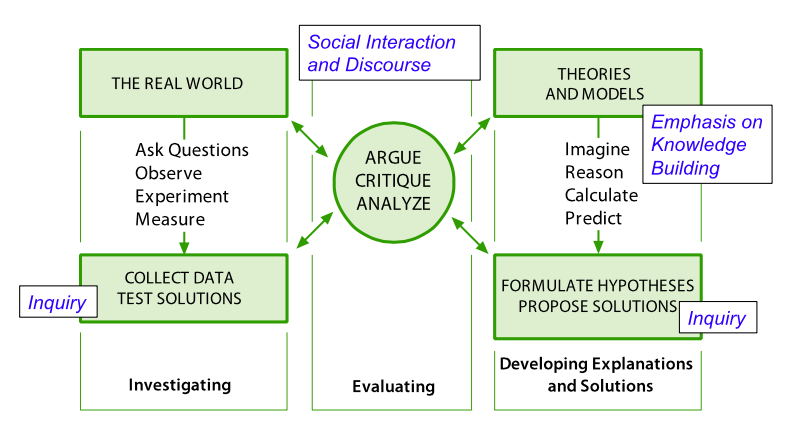
Captured from Brian Reiser's paper cited below.
Captured from Brian Reiser’s paper cited below.

Feuer, M.J., Towne, L., &  Shavelson, R. J.  (2002) Scientific Culture and Educational Research. Educational Researcher 31(4) 4-14.

U.S. Department of Education (2003). Identifying and implementing educational practices supported by rigorous evidence:
a user friendly guide.  Available at http://ies.ed.gov/ncee/pubs/evidence_based /evidence_based.asp.

Reiser, B. J. (2013). What professional development strategies are needed for successful implementation of the next generation science standards? Paper prepared for K12 center at ETS invitational symposium on science assessment. Washington, DC. http://www.k12center.org/rsc/pdf/reiser.pdf.

Clearly Feuer, Towne, & Shavelson (2002) were at odds with the policy emphasis captured in the “user-friendly guide” by the Department of Education in (2003), though they were clearly open to increasing use of randomized, controlled trials: “Although we strongly oppose blunt federal mandates that reduce scientific inquiry to one method applied inappropriately to every type of research question, we also believe that the field should use this tool in studies in education more often than is current practice…. We have also unapologetically supported scientific educational research without retreating from the view that the ecology of educational research is as complex as the field it studies and that education scholarship therefore must embody more than scientific studies.” While they leave the field open for many different communities of inquiry, the DOE report narrows the focus onto just one. This narrowing of the range of inquiry, in my view, is short-sighted and extremely limiting in three ways.

First, as we learned in Organizing Schools for Improvement, change takes time. It often takes five years for a new program or community to be built and show results. There can be an implementation dip, where the disruption of change actually makes things worse initially. As we learned at Waukesha STEM this week, the first six months of their new idea of “connect time” was true chaos with teachers ready to get rid of it immediately. Now it is one of the pillars of the way they have changed to student-centered learning. Second, the narrowing of a focus to one kind of method as suggested in the DOE report means that there are fewer questions that can be asked. For example, there is no ethical way to use randomized, controlled trials to understand the experience of homeless students in schools. As Feuer, Towne, & Shavelson state, “The question drives the methods, not the other way around. The overzealous adherence to the use of any given research design flies in the face of this fundamental principle.” Finally, it is increasingly clear that a diversity of ideas drives innovations and solutions, and “the presence of numerous disciplinary perspectives (e.g., anthropology, psychology, sociology, economics, neuroscience) focusing on different parts of the system means that there are many legitimate research frameworks, methods (Howe & Eisenhart, 1990), and norms of inquiry.” (Feuer, Towne, Shavelson, 2002) We need multiple Discourses (Gee, 1990) in educational research.

The Department of Education report is meant to address the gap between research and practitioners. Feuer, Towne, and Shavelson quote the National Research Council that said, “Educators have never asked much of educational research and development, and that’s exactly what we gave them.” What I found compelling about Reiser’s (2013) paper on professional development for the Next Generation Science Standards was that it seamlessly wove theory and practice, describing the cultural shift to one line messages, giving examples of the way practice is now, and describing what it should be. For example, Reiser writes, about the “shift from learning about… to figuring out,” and “Inquiry is not a separate activity—all science learning should involve engaging in practices to build and use knowledge.” Further, when Reiser outlines the key principles for professional development, lists a series of recommendations, and includes practical examples, like the suggestion, “One fruitful way to engage teachers with records of practice is for teachers to analyze video cases of teaching interactions.” In the frame of distributed leadership, changing systems of practice happens through changing the routines, and this paper clearly brings research to bear on precisely what is being done in the classroom.

(Somewhat more philosophically, it is ironic that just as the Next Generation Science Standards are shifting towards an approach of describing phenomena first and then trying to explain it, while Department of Education clings to the old scientific model of inquiry that dictates rigid positivist methods.)

What are the implications for school leaders? I see the appeal of a one-size-fits-all, tried-and-true, what works solution, but I think most educators know that nothing with kids (or teachers, for that matter) works that way. Yet when faced with a field of educational research that seems to have a lot of internal conflict about what is considered “rigorous” research, what do you do first, on Monday, when the kids show up? I think this is why the ideas of design and professional community are appealing as a way of improving educational systems. Design, to me, is not about realizing one fixed answer, but rather is constant process of listening and testing, embedded in local context rather than seeking to minimize it. Similarly, focusing on professional community builds the capacity of people and context, rather than seeking to minimize them. Just as inquiry is not a separate activity when learning science or for educational researchers, it is not a separate activity for leaders, either.
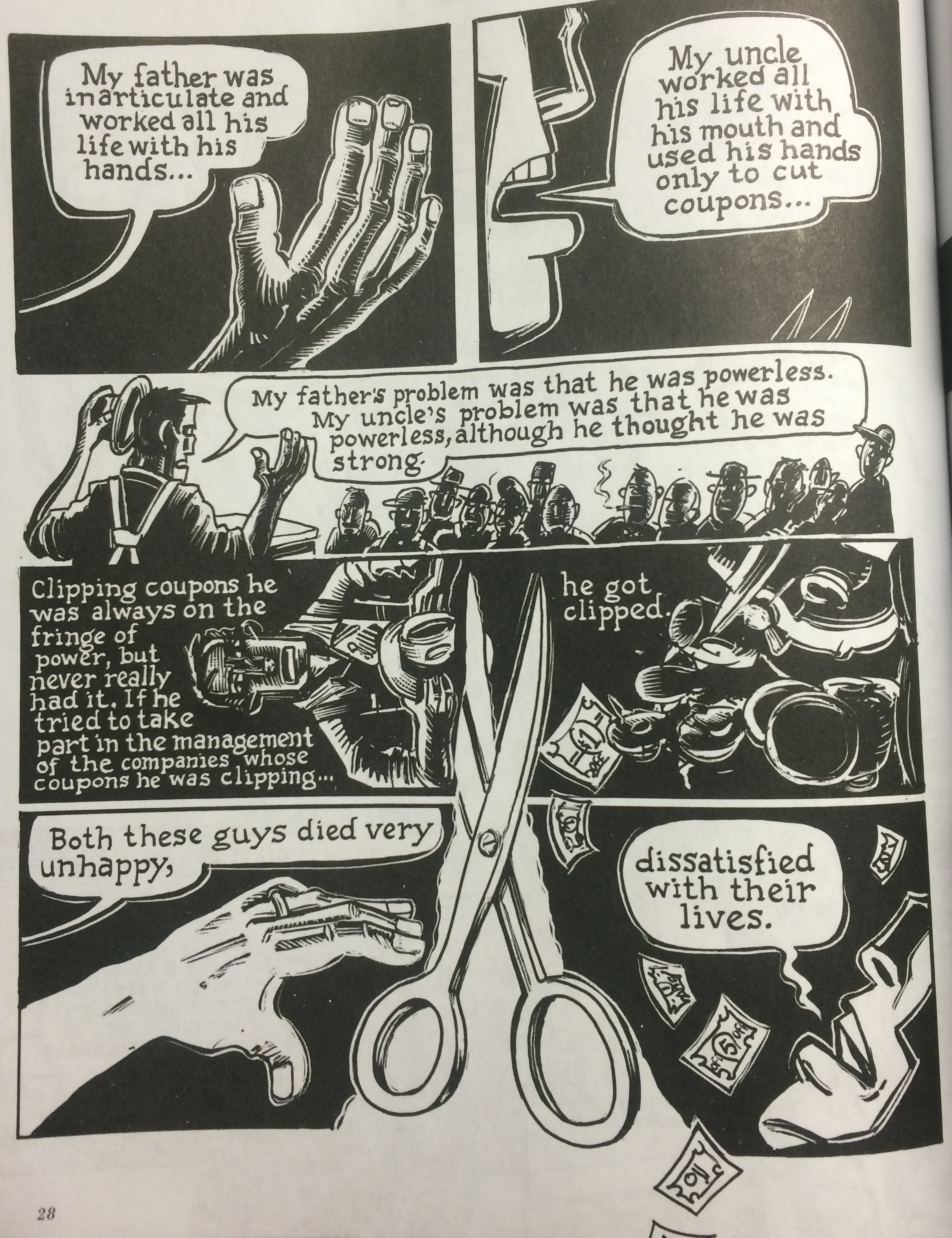
Studs Terkel’s Working, a graphic adaptation by Harvey Pekar

IMG_3321 IMG_3320

This is a reaction paper written for a course on Education and Work…

Pekar, H., & Buhle, P. (2009). Studs Terkel’s Working: A graphic adaptation. New York: New Press

Of course the first thing I noticed was that they didn’t profile any teachers! But I think this actually says something about my reaction to the book. The visual form of a graphic novel made the stories very intimate, moreso than when I listen to something on This American Life, for example, because of the scene and surroundings. There were some that I could picture myself in. The pictures amplified the already intimate stories of individual and community struggles, frustrations, joys, anxieties, discord, desires. In particular, the chapter about Dolores Dante, the waitress, brought to life the environment, the juxtaposition of the job with customers. On page 76, you see the way she is positioned over the customers, visually manipulating them, paralleling her attitude of control. On page 85, the acrobatics or ballet of keeping the tray balanced is wonderfully represented.

The most heart-wrenching story for me was of the migrant boy, particularly this line: “The children are the ones hurt the most. They go to school three months in one place, then on to another. No sooner do they make friends, they are uprooted. Right here your childhood is taken away. So when they grow up, they’re looking for this childhood they have lost.” (p. 22) It is so easy as a teacher to forget the world a child faces outside your classroom, especially when as a teacher you personally have no experience of what they’re going through. One summer, I taught in a “catch up program” for kids in an old mill town in Massachusetts. There was significant family issues for many of them, and one of my students spent the mornings sleeping under the desks. The supervisor’s attitude was that if this is a safe space for her to sleep, then that is the best thing we can do for her.

Finally, the last visual that came through strongly for me was the image of the hand, particularly in the story of the organizer. This is a fairly obvious symbol, but powerful nonetheless. You see the comparison between the father that worked with his hands and the uncle who used his hands only to cut coupons. (p. 28) You can then see the hand cutting the coupons on the left and bills falling, beginnig the motion that then opens onto the pyramid on the opposite page. The hands are prominent on the pyramid, working against each other in pushing the pole or turning the machine of some kind. The pyramid with the Eye of Providence at the top, similar to the backside of the dollar bill. On the dollar bill, the pyramid sits under the mottos “Annuit coeptis” (he favors our undertakings) and “Novus order seclorum” (roughly, new world order). Literally, the working people are attempting to change the way the world works through collective efforts of the hands, but I think you could see their efforts as futile due to the arms at the top that hold the machinery of the world still. The arms come from the sides, with suit coat sleeves and tie tacks, one hand resting easily on the top, “College professors and management types…” on one sleeve and “They have the kind of power Eichmann claimed for himself.” Eichmann was one of the major organizers and logistics manager of the Holocaust. He was found in 1960 by Israeli intelligence in Argentina and convicted of crimes against humanity. Below the left arm, is written, “They have the power to do bad and not question what they’re told to do,” which was Eichmann’s defense in his trial. The images are powerful and draw you in, revealing layer after layer of symbolism and meaning.

Last year, I took a MOOC on Comic Books and Graphic Novels, taught by Profession Kuskin at University of Colorado – Boulder. Not only was it a great course: I learned so much, and it gave me the skills for reading a graphic novel and a profound appreciation for the medium. I’m not sure if they’re run the course again, but I would definitely recommend it!

How do we use information?

Reaction to the following articles:

Bryk, A. (2010). Organizing schools for improvement lessons from Chicago. Chicago: University of Chicago Press.

Excerpt from Gee, James Paul. (1990) Social Linguistics and Literacies: Ideology in Discourses, Critical Perspectives on Literacy and Education. London [England]: New York.

Newmann, F.M., Carmichael, D.L., & King, M.B. (in press). Chapter 6. Authentic Intellectual Work: Improving Teaching for Rigorous Learning. Thousand Oaks, CA: Corwin

How do we use information? This is a really broad question and might not seem on topic for this week, but I’ll get there. First, I returned to Chris Thorn’s “Knowledge Management for Educational Information Systems: What is the state of the field?” (2001) that we read last semester. He defines knowledge and it’s relationship to information and data. Data is facts, information is facts + context, knowledge is the facts + context + experience, judgement, intuition, values. (These are actually definitions from Epson, 1999, that Thorn cites.) There is thus a progression from data to knowledge of as facts are brought into a Discourse. Two different Discourses might take the same data and come out with different knowledge. Thinking about it in this way led me to think about what we have discussed the last two weeks about how administrators have the power to bring a policy into their Discourse (if they have established one, of course).

But returning to the question of how we use information, what I find so exciting about Authentic Intellectual Work (AIW) is that it is an information gathering tool that seeks to measure what I would call the “good stuff” of teaching and learning: the conversations, the higher-order thinking, the student interest, social support. What’s more, the implementation framework actually establishes a Discourse around the use of the information, changing the way educators interact and centering the conversation around the empirically gathered information – not about thoughts, intentions, feelings, etc. Teachers are coached on how to see and understand the information that is already in their classrooms.

In a different turn on how we use information, Organizing Schools for Improvement uses data to show relationships in a way that I had never seen before. It was the first time I had seen a quantitative analysis of systems that even attempted to show synergistic effects, such as Figure 4.11 (p. 114), showing that schools strong on two supports did substantially better than those strong in just one or the other support. While I have struggled with accepting the use of math and reading scores as measures of “achievement,” I think the way it was used here has merit. Since the schools deemed “improving” were the ones in the top quartile, it does seem that this would represent genuine learning. It seems it would be hard to exclusively teach to the test and get into the highest quartile.

Continue reading “How do we use information?”

Reaction: Distributed Leadership & Systems of Practice

Aren’t these beautiful, mathematical systems?

Readings this week:

Halverson, R. (201?). Systems of Practice: How Leaders Use Artifacts to Create Professional Community in Schools.

Spillane, J., Halverson, R., Diamond, J. (2004). Towards a theory of leadership practice: a distributed perspective. Journal of Curriculum Studies. 36 (1): 3-34.

I’ve read so much in the past four months (more than I have in the past 10 years) that sometimes I lose track of what I wanted to come to graduate school to study in the first place. The readings this week took me right back to questions I wrote in my personal statement: “How can a system-wide professional growth model be designed that inspires a professional culture? Is cultivating passionate and engaged teachers enough to shift an institution? What other structures or leadership opportunities do teachers need to feel connected?”

The distributed perspective for leadership presented by Spillane et al. proposes that leadership is never limited to one person alone. It is distributed across actors, tools, and context. The relevant level of analysis for the practice of leadership is the tasks that leaders do. Changing the practice of leadership thus begins with changing the tasks and routinizing these new tasks, eventually rooting the changes into the norms or culture of the organization. What resonates most with me is the fact that distributed leadership is both a way to see leadership and a way to change it.  Continue reading “Reaction: Distributed Leadership & Systems of Practice”

Chapter 3, Organizing Schools for Improvement

A little delay since the last two posts (Intro & Chapter 1, Chapter 2)… Christmas vacation = no preschool, so life has been very full of other things. Also, took a little trip. Here’s my view as I write this morning:

/home/wpcom/public_html/wp-content/blogs.dir/db1/39059569/files/2015/01/img_0069.jpg
Life is good!

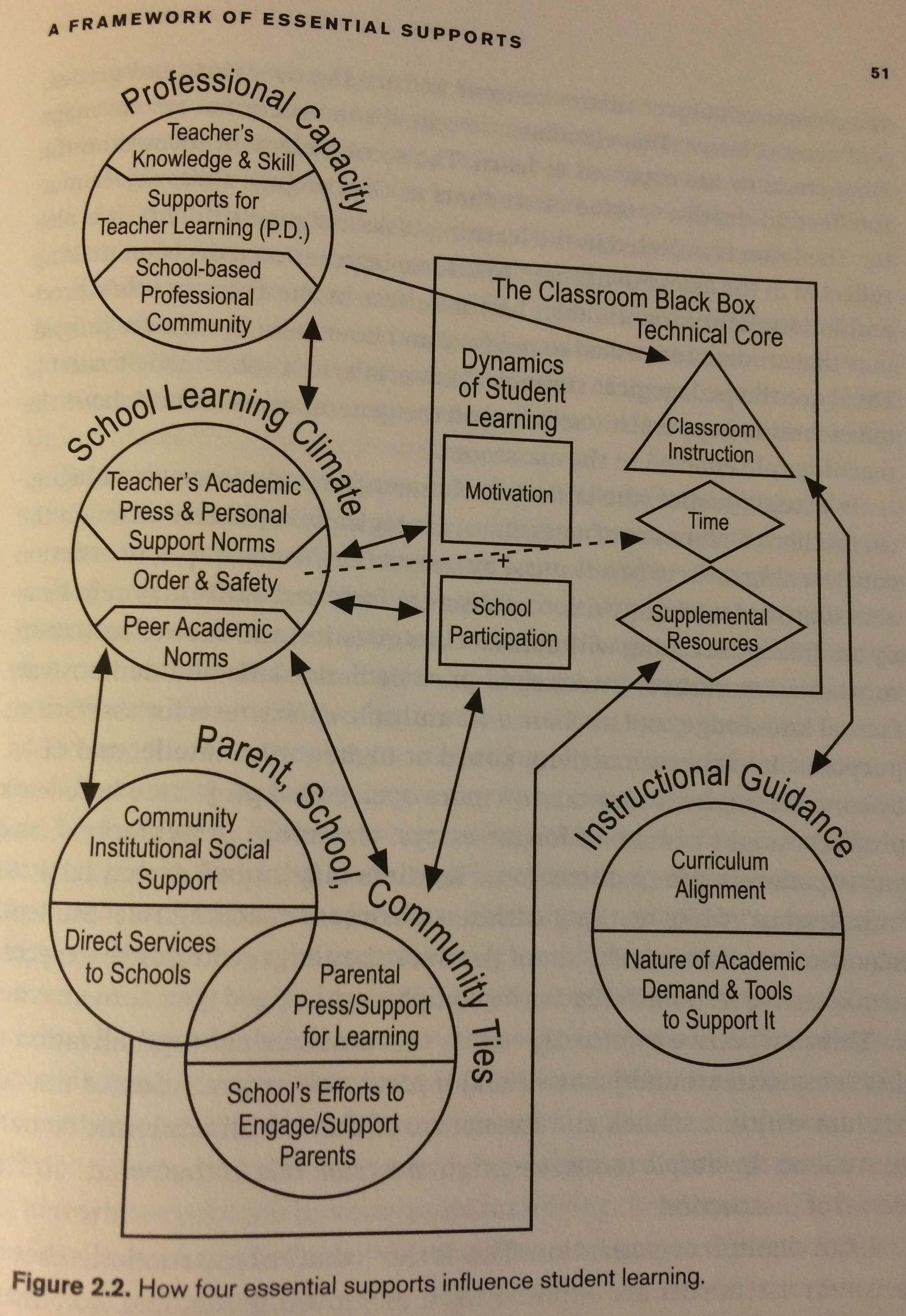
In Chapter 2, the authors introduced their five “essential supports”: 1) school leadership, 2) parent-school-community ties, 3) professional capacity, 4) student-centered learning climate, and 5) instructional guidance system. Note that these are supports, as in they provide conditions that “substantially influence” (p.79) the work of the school, but they do not directly cause the improvement. This is the nuance of a systems approach. The authors also make the point that they are essential and will use a quantitative methodology to show that improvement stagnates without them.

Because of this systems approach, the idea of “holding other factors constant” doesn’t make sense. If each support is reinforcing (or undermining) to the other, holding others constant doesn’t actually give a sense of how the two systems interact, sort of like trying to understand how a steering wheel functions independent of the wheels. This also means that statistical approaches that are designed to control for particular variables don’t work. Thus the approach that is used is “a form of analytic spiral” (p.80). Basically the authors use a large longitudinal database of surveys and test scores to explore these supports. I would be interested to know all the other ideas they tried before coming up with their final analysis. It comes across quite straightforward, but the process was no doubt complex.

Again, they use reading and math test scores, but they use them only as an indicator of improvement if they were in the top quartile or stagnation if they were in the bottom quartile. This approach makes sense to me as the top and bottoms are obviously showing improvement or stagnation whereas those in the middle are harder to parse. Perhaps as my quantitative fluency improves I will have a more critical eye to their methods, but for now I will take it as presented.

A strength of their analysis is that they present both the schools that are improving and stagnating. This bolsters their argument because it shows that schools with high levels of the supports are more likely than chance to show significant improvement whereas schools with low levels of the supports are more likely than chance to show stagnation.

Most interesting to me was the cumulative effects of the supports. Through an aggregated indicator score for the supports compared to improvement in math, reading, and attendance, the authors show a distinct correlation with strength or weakness in the supports.

/home/wpcom/public_html/wp-content/blogs.dir/db1/39059569/files/2015/01/img_0073.jpg
P. 94

Currently Me

The best inspiration sometimes comes from fellow bloggers… thanks to RunSingTeach’s Sarah Barton Thomas for posting this today, with her list inspired by Lindsay’s List.

Here’s my list

Currently: Dogs are fed and waiting for their walk, drinking coffee, husband is at work, kid will wake up any minute (must type fast!).

Current Inspiration: Minimalist and tiny houses. We need to downsize and get a handle on all the stuff in our life.

My favorite from a tiny house on Sauvie Island, near Portland, Oregon. Picture from: http://www.jhinteriordesign.com/tiny-house/ http://tinyhouselistings.com/sauvie-island-tiny-house/

Current Book: Organizing Schools for Improvement: Lessons from Chicago. Seriously. Must catch up on blog posts this week.

Current Tune: Wisconsin Public Radio has Sunday afternoon program called Simply Folk that I LOVE. Yesterday they started with the Indigo Girls playing In the Bleak Midwinter, which is one of my favorite holiday tunes.

Current Drink: SO Delicious non-dairy egg nog

Current Foods: Homemade applesauce. Making and freezing batches for reusable pouches. For the kid, not me.

Current Show(s): (guilty confession) I just finished watching the final season of How I Met Your Mother. We used to watch it but lost interest when it dragged on too long, but I wanted to know it ended!

Current Outfit: Leggings under skinny black jeans (it’s cold here!), striped black and beige shirt from the Loft, silver hoops, Frye’s boots, and curled hair. When I dress up. Otherwise: well worn jeans (plus long underwear – have I mentioned it’s cold?) and nike sweatshirt with grey Lululemon Vinyasa Scarf.

Current Indulgence: Coconut cream dark chocolate and Pinterest and aforementioned coconut egg nog.

Current Want: New book bag – must be classy, waterproof, possible to bike with, backpack/shoulder bag, fit my computer and water bottle but not too heavy… I don’t think it exists.

Current Gratitude: My kid LOVES books. We read “Are you my mother?” over and over, first thing when he wakes up and before bed. He also loves “I am a bunny,” and when we found a hollow log at the dog park yesterday, he recognized it as “Nan-itch” (Nicholas)’s home. So sweet.

Nicholas the Bunny Image from http://ecx.images-amazon.com/images/I/518Ae2Zwt9L.jpg

What’s happening with you, right now?

Chapter 2 of Organizing Schools for Improvement

This is a follow up post to yesterday’s introduction & chapter 1. I’ve been enjoying this reading immensely because it quantitatively presents an understanding the support systems of a school and shows interactions between them. Many of the questions that I have had around emergent properties like how innovation affects school culture could be approached with these methods. The primary phenomena investigates is “how to better organize schools to support improvements in student engagement and learning” (p.48).

I find myself drawn to this more descriptive approach to research rather than as an interventionist. I think this is because the questions that I ask are on a large scale, so the idea of creating an intervention to “test” them would take years. It makes me think of the Hertzpring-Russell diagram, a plot of the absolute magnitude and temperature of stars, revealing the “main sequence” of stellar evolution. I wonder if I could make something like that for restructuring of schools… Hmmm.

Chapter 2: A Framework of Essential Supports

In this chapter the thrust is to explore the framework that emerged from the data. It’s worth noting that the criticism of business in the mid 80s was that large bureaucratic organizations were failing because they did not “respond well to local needs, had little capacity to learn, and stifled rather than nurtured innovation” (p.46). Sounds like the Chicago Public Schools, thus the Chicago School Reform Act. With more autonomy for restructuring at the school level, it makes sense to look at the school as the unit of research. This departs from some reform efforts at that time, which focused exclusively on instruction and the role of the principal as instructional leader.

The stated goal of the “theory of school organization and its improvement” (p.44) is to be grounded in practice. The tension between theory and practice is longstanding. (I have seen theory and practice best unified through design, so it will be interesting to see if there are similarities there. Also, it is hard for me to both approach this work as a practitioner and as a researcher, but if that is the goal it will be important to evaluate it from both perspectives.)

Second, the framework is meant to be analytic, in the sense that a practitioner could use it as a tool to guide school improvement. (This resonates with me after what I said above about creating a H-R-like diagram of school characteristics that creates a “main-sequence.”) The framework is based in organizational theory but also informed by contingency theory, given that this is an analytic tool meant to guide school improvement rather than a recipe for how to do the best school improvement.

They get at this with the “baking a cake” analogy to the concept of “essentiality.” You have to have certain ingredients (e.g. flour, sugar, eggs, baking powder, and salt) to make a cake, but the exact ratios are a little flexible. This is like school improvement: without one ingredient, the improvement isn’t going to happen. On the other hand, focusing exclusively on the exact right amount eggs also isn’t going to make it happen if you’ve got no flour. This is why it’s emergent. All ingredients need to be there.

Figures 2.1-4 – these give the four levels of organization.

IMG_2837 IMG_2838 IMG_2839 IMG_2840

(I debated whether to post these because I don’t want to violate copyright, but seeing them next to each other is really helpful. In the book they are separated on different pages and this way you really get the zoom out of each level and a sense of just how complex the system is!)

An interesting component that they notice was missing from their data collection is the managerial dimension of school leadership. The researchers note that this became obvious after 1996 when the focus was on non-improving schools and found that there were schools where just the basic routines were not getting done. Management is a necessary but insufficient condition for improvement.

5 subsystems: School leadership, parent-community-school ties, professional capacity, student-centered learning climate, instructional guidance. There are 14 indicators for these subsystems developed to “capture the degree to which the essential supports developed in Chicago elementary schools” (p.71).

Up next, Chapter 3.

Reflections on my first semester of graduate school

I finished my first semester of graduate school! Hooray! It has better than I could have ever imagined, even when I started planning this 4 years ago. I feel incredibly fortunate to have found my way to this place at this time.

Here are a few thoughts:

  1. Sometimes it feels like I don’t “do” anything all day. There is no immediate feedback from students or peers, no fires to put out, sometimes a meeting, usually a couple journal articles.
  2. Is it worth my time to do this? There are so many things to join, brown bags to attend, books to read, concepts to understand, MOOCs to take, blog posts to write. Should I?
  3. What will my question be? What will my research be? Is it edgy enough? Is it radical enough? Is it interesting enough? Will it get me a job? Will I like it? Will it be a profound change in the life of all people teaching in schools everywhere for ever and ever? Will I finish it?
  4. My questions change every day, if not every hour. After a lecture about the future of higher ed I debated jumping from K-12 focus to higher ed. Wait a minute. Do I want to read about it or devote my intellectual life to it? Is it interesting or fascinating?
  5. I want to stay here forever!
  6. I want to graduate at soon as possible to escape the cold weather and earn a salary.
  7. Will anyone be interested in my research? Do I even belong here? *Sigh*

This spring I’m taking four classes, one of which is public school law, which I’m super excited about. I’m not really sure why, but maybe because law school is one of those paths not taken, and this might be a glimpse in that direction. I’m also going to take an Interactive Museum Exhibit Design class, mostly because it sounds fun and I’ll get to make stuff. Onward!


As always, I am grateful for a supportive partner, who tucks the kid in at night when I’m at class and listens to me babble about things I’m thinking about. There is no way my ideas would be as good or my spirits as high or my life as full without him.

Introduction & Chapter 1, Organizing Schools for Improvement

Book cover. Retrieved Dec 16, 2014 from http://ccsr.uchicago.edu/sites/default/files/styles/galleryimage/public/publications/6942book_cover.png

One book I’m reading during the “recess” from classes is Organizing Schools for Improvement: Lessons from Chicago (2010), by Bryk, Sebring, Allensworth, Luppescu, and Easton. As I’ve done for other independent readings, I’ll try to summarize the chapters and add my own reflections at the end. I’ve found that writing these blog posts improves my comprehension and memory of the research. It’s like all that research on learning actually works!

Introduction

Policy context: The research presented in this book is based on the reform initiatives in the Chicago Public School (CPS) District beginning with the Chicago School Reform Act of 1988. Essentially, Local School Councils (LSCs) were given the authority to determine how to education their children, including hiring the school principal. Eight years later, some schools had shown marked improvements while others languished; this research effort tried to understand why. Continue reading “Introduction & Chapter 1, Organizing Schools for Improvement”

Reaction 12: DIY, MOOCs, and Higher Ed

Reading this week:

Carey, K. (2012). The Siege of Academe. Washington Monthly, 34–44.

Kamenetz, A. (2010). Edupunks, Edupreneurs, and the Coming Transformation of Higher Education. White River Junction, Vermont: Chelsea Green Publishing.

Schechtman, N., DeBarger, A. H., Dornsift, C., Rosier, S., & Yarnall, L. (2013). Promoting Grit, Tenacity, and Perseverance: Critical Factors for Success in the 21st Century (pp. 1–126).

If there is one thing harder than revolutionizing higher education, it might be capitalistic treatment of the environment. In September, there was a report released by the Global Commission on the Economy and Climate that aimed to show how governments and businesses could “improve economic growth and reduce their carbon emissions together.” (Economic Growth and Action) Instead of companies sacrificing profit for the publicity of being environmentally friendly, now there is an economic logic to reducing costs through mass transit, restoring land, renewable energy, etc. What I appreciated about at least the idea of this report was designing systems and logic to match the goals of seemingly antagonistic forces. Capitalism doesn’t have to be anti-environment if it is in the businesses best interest to maintain a healthy environment. As we improve understandings and data of ecosystems, manufacturers or refineries understand the way they negatively or positively impact the environment, which in turn hurts their profits.

How can we design systems in education where key players in institutions (in this case, educators) see that it is in their best interest to exploit the possibilities of technology? Unfortunately most of the rhetoric used is from a capitalist perspective of efficiencies and consumption, which educators, in general, are philosophically opposed to. In Peurach and Gumus (2011), in an article reviewing leadership in School Improvement Networks such as charters, I was struck by the quote, “Critics express concern that this new school improvement market will be more responsive to principles of competition and consumerism than to principles of student welfare and the public good, with student achievement potentially taking a back seat to increasing the scale of operations or (in the case of for-profit providers) showing positive returns on investment.” (p. 3) How do we design as system that is responsive to the principles of competition and consumerism but prioritizes student welfare and public good? Focusing on efficiencies and costs doesn’t get at the stubborn, “heavily regulated, culturally entrenched,” (Carey, 2012) nature of higher education.

Could data bridge the ideological gap between the Silicon Valley edupreneurial venture capitalists and traditional higher education? I think about the Houston KIPP school that is changing their policies because of they acknowledged the high teacher turnover rate and the corresponding negative affect on student learning and cost. They are now offering onsite daycare and lactation rooms, flexible schedules or shorter hours, and even staff priority in admission lotteries. (Monahan, 2014) Is it naively optimistic to think that unbundling the traditional structures of education would introduce enlightened policies like this? Or is this a capitalistic mirage? “Digital philosophers have become fascinated by the potential of a humanized use of technology to liberate people from all kinds of bureaucratic institutions that have defined modern life for more than a century.” (Kamenetz, p. 114) Will this liberation be a net improvement for all or for some?

I feel like Richard Sennett is looking over my shoulder, shaking his head, warning of those who will lose out in this fresh-page version of education. What happens to those who are not able to access this free and abundant knowledge available through the internet? What happens to those who are not driven to do-it-themelves? What happens to those who are lost in the shuffle? As Wood (2014) states about the Minerva project, “If Minerva fails, it will lay off its staff and sell its office furniture and never be heard from again.” Is this the kind of ad-hoc fail-fast try-anything culture we want for the education of our children?

But then, society today really is different. As Carey points out, “When colleges were originally built, there were only two ways to get scholarly information: read a book or talk to a smart person.” (p. 40) Connections and personal learning networks are a reality that will continue to unbundle education. If the music industry is any indication, it is the open source, networked, decentralized models that will persevere and traditional educational organizations ignore it at their peril. It is more than a little ironic that institutions for teaching and learning are not themselves flexible and adaptive to learn as organizations.

At the beginning of this class, the question was posed, “Are learning technologies the solution or the problem?” After this week’s reading, I feel like they are the reality, dominated by the rhetoric of the fresh-page sector (i.e. Silicon Valley edupreneurs). Perhaps the innovation we need is a sociotechnical system design that unifies the seemingly antagonistic domains of capitalism and education towards a common utopia. Just that 🙂

Additional Citations:

Monahan, R. (2014). Charter Schools Try to Retain Teachers with Mom-Friendly Policies. The Atlantic. November 11, 2014. Retrieved November 28, 2014. http://www.theatlantic.com/education/archive/2014/11/charter-schools-now-try-to-keep-teachers-with-mom-friendly-policies/382602/

Peurach, D. J., & Gumus, E. (2011). Executive Leadership in School Improvement Networks : A Conceptual Framework and Agenda for Research. Current Issues in Education, 14(3), 1–17.

RELEASE: Economic Growth and Action on Climate Change Can Now Be Achieved Together, Finds Global Commission. (2014). Retrieved November 28, 2014, from http://www.wri.org/news/2014/09/release-economic-growth-and-action-climate-change-can-now-be-achieved-together-finds

Sennett, R. (2006). The Culture of the New Capitalism. New Haven: Yale University Press.

Wood, G. (2014). The Future of College. The Atlantic. September 2014. Accessed November 28th, 2014. http://www.theatlantic.com/features/archive/2014/08/the-future-of-college/375071/

Continue reading “Reaction 12: DIY, MOOCs, and Higher Ed”