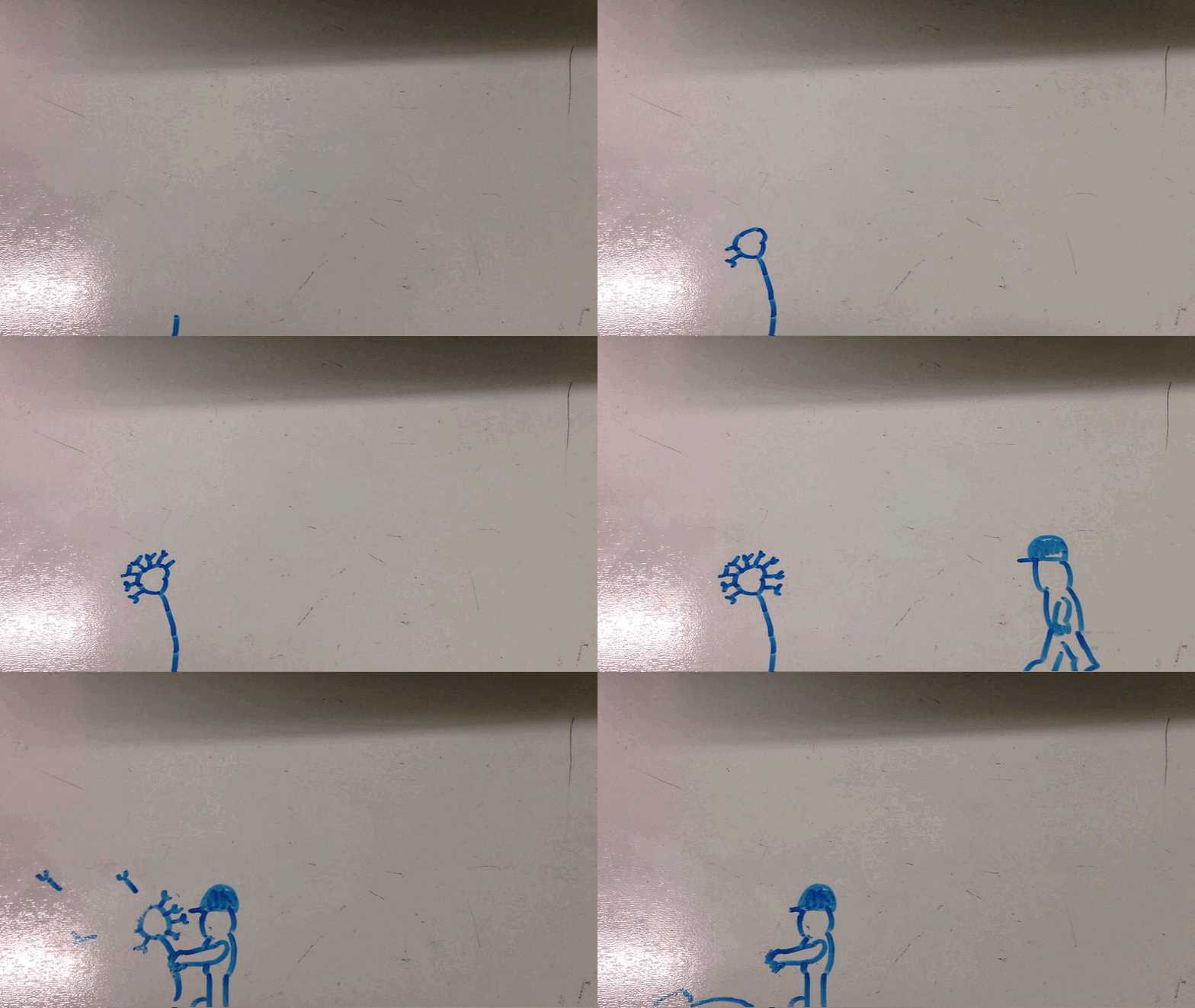
Tonight our technology and leadership class met at the Bubbler, a maker program/space at the downtown branch of the Madison Public Library, in order to learn more about the maker movement. In their media lab, we got to use their set up for stop motion animation, and this was actually the first time I’d ever done a project like this, despite all the times I’ve supported it with kids. This was inspired by my weekend with my son, who currently loves finding dandelions, picking them, and blowing away all the florets. Enjoy!
Also this is my 100th post! Reflection on that coming soon…
But for now, this post is a reaction to Neil Gershenfeld’s article, How to Make Almost Anything: The Digital Fabrication Revolution, and Erica Halverson’s paper, Digital art-making as a representational process:
If you are a traditionally trained, career teacher, you likely have no idea how creative processes work in industry. I think one of the most compelling parts of the Youth Media Arts Organizations is that they use real processes of production, like Reel Works pitching to actual directors at an actual film studio. This is what makes it authentic rather than contrived. Without personal experience as an artist, I think teachers struggle to facilitate authentic student work in this area. I know that I personally have assigned video projects without any discussion of what the rules of the genre are, types of films, camera angles, storyboarding, etc. “Creating art mindfully, that is learning how to construct and critically evaluate these representations, requires scaffolded instruction” (Halverson 2010). Being able to scaffold instruction requires deep content and process understanding by the teacher, which the majority do not have. For this reason, students who are good with iMovie flair might dazzle their teachers with effects, and teachers then mistakenly equate the ability to manipulate software with understanding the rules of genre and/or content understanding.
I see three opportunities for bridging this gap between the experiences we want kids to have and what is currently happening. First, I think we need to recruit and enlist second career teachers who come from within industry. I see this happening at the Sullivan Center at the ‘Iolani School, an independent K-12 school in Honolulu, where they have a game designer, software architect, and studio and fabrication artist, among others, as faculty. Alternately, in the same way that the National Writing Project promotes teaching writing by developing teachers as writers, there could be art and maker institutes for teachers to develop themselves as creators. I would also love to see arts integration coordinators who support teachers designing, implementing, and assessing lessons. This might see new literacies (Knobel and Lankshear 2007) and “tasks that put the arts forward” (Halverson 2010) take root K-12 schools.
Gershenfeld (2012) in his article also addresses making, but in a different context and purpose. For the most part, his article is historical or explanatory, but there was one point that I thought stood out: the parallel comparison made between personal computing and fabrication. Although some could not imagine what people might do with personal computers, users adapted its design to their own desires (shopping, connecting, sharing). One of the radical ideas of the Ito et al. (2008) report was that they observed students “in the wild,” seeing how they actually used the tools, rather than assuming that they would just be used as they were designed. I think it is telling that in Gershenfeld’s Bits and Atoms class, it was research students who came up with innovative ideas, adapting it to the “market of one” (Gershenfeld 2012), and that as adults, we often can’t fathom what to do with something like a 3D printer.
One final point is to tie the art and process of “making” in with Sennett’s three key themes for navigating the era of new capitalism: narrative, usefulness, and craftsmanship. I see making, whether digital media or fabrication, as providing opportunity for developing personal narrative and craftsmanship through mindful design, production, and performance, and the performance of making, as seen in participatory cultures (Jenkins et al. 2006) and the FabLabs in Manchester and Barcelona (Gershenfeld 2012), provides spaces where people feel useful and connected. Perhaps in contrast with the fearful reaction by many (Gershenfeld 2012), I see the maker movement as a fundamentally hopeful trajectory for individuals and communities.
References
Gershenfeld, Neil. (2012, September 27). How to Make Almost Anything: The Digital Fabrication Revolution. New York Times.
Halverson, Erica. (2010). Digital art-making as a representational process. Paper presented at the International Conference of the Learning Sciences.
Ito, M. et al. (2008). Living and Learning with New Media : Summary of Findings from the Digital Youth Project (pp. 1–58).
Jenkins, H., Clinton, K., Purushotma, R., Robison, A., & Weigel, M. (2007). Confronting the Challenges of Participatory Culture: Media Education for the 21 Century (pp. 1–72).
Lankshear, C., & Knobel, M., Eds. (2007). A New Literacies Sampler.
Sennett, Richard. (2006). The Culture of the New Capitalism. New Haven: Yale University Press.
Gee, James. (2009) Good Video Games and Good Learning.
Klopfer, Eric; Osterweil, Scot; Salen, Katie. (2009). Moving Learning Games Forward: Obstacles, Opportunities, and Openness. Report from the Education Arcade, MIT.
Squire, Kurt. (2006). From Content to Context: Videogames as Designed Experience, Educational Researcher. 35(8) 19-29.
Video games and learning is something I have thought a lot about (and apparently blogged a lot about! here, here, here, here, here, here, here, and here) in the last 4 years since I began a project integrating SimCity into my 7th grade science classroom. I participated in the Games and Learning MOOC that Squire and Steinkuehler taught last fall, Reality is Broken by Jane McGonigal is a favorite, and this spring I finally got a chance to present on the topic of video games and learning to parents and a few teachers at my school. This week’s readings built on this foundation and affirmed a lot that I already believe, but I want to add an analogy that I think is helpful in terms of why games belong in education and one aspect that I think was missed.
First, though, I feel like I need to come clean and admit that I’m a gamer. Whenever I talk about games in education, I almost always preface it with “I’m not really a gamer.” I say it for two reasons. One, because I do regularly play major video games like WoW or Call of Duty, so my gaming does not align with what people stereotypically associate with the label “gamer.” Two, if I did identify myself as a gamer, it might prevent honest conversations with teachers or parents who are skeptical or negative about games, whereas presenting myself as a non-gamer allies me with them. I think this gets at the deep attitudinal barriers that Klopfer et al. (2009) refer to. But when I read the descriptions of the range of what is considered gaming, it’s me. My earliest memories include being allowed to “pick tiles” for my mom’s Scrabble game, I got Yahtzee with 3’s when I was 3 (very exciting), finally beating my older brother at Monopoly (which he contested, of course), and staying up very late playing Tetris against my cousin with our linked Gameboys. I spend and have spent a lot of time playing games; I’m a gamer.
One way that I find is helpful to address the deep skepticism and negative reaction to video games in the classroom is through an analogy. (It is not my own: I credit it completely to the director of educational technology that I worked with at OES, Brad Baugher.) While it’s an easy comparison to talk about how video games are like athletics, he took it one step further. He argued that the way video games are played right now is a lot like pick up games: informal, unsupervised, unregulated, ad hoc, and exclusionary. We believe (and spend a lot of money) on incorporating sports into schools because we see that they teach valuable life skills like grit, persistence, cooperation, and inclusion, and we employ coaches to facilitate this. Incorporating video games into the classroom is a lot like bringing them into a space where teachers can facilitate the game play, such as incorporating reflection on the experience.
The aspect that I think was missed, particularly in the Education Arcade’s report, is involving students in the creation of games. Klopfer et al. (2009) mention this in the example of Gamestar Mechanic, but not really elaborated on: “The Gamestar Mechanic team argues that by participating in and understanding the interactions of multiple complex systems, they are developing skills that are crucial for an increasing collaborative, networked, and high tech society.” This meta-awareness is crucial, and this is what I think needs to be used to create a sense of urgency amongst educators. In my experience with SimCity, and here I will make an unresearched generalization from my anecdotal though professional experience, students rarely asked why the games were designed they way they were. Boys were much more likely to prod the limits of the game and test cheat codes but without asking fundamental questions about the assumptions of the games, whereas girls were more likely to accept the gameplay as they were and seek to optimize their play within the rules, but also without questioning the game itself. I think this says a lot about how gender plays out in the game of school in general. Engaging students in game design will improve their understanding that games are artifacts designed by people who have ideologies, beliefs, and values, in the same way that learning to create movies or use photoshop helps them understand the media they see. By extension, students who learn to identify the rules and ideologies of a game can ultimately learn to question how and why “real life” societies are governed by rules and ideologies. I, perhaps optimistically, see intentional and reflective game play as an exploration and understanding of who we are and the world we live in.
The Campaign for Grade-Level Reading begins their report on “Pioneering Literacy” with a focus on the importance of the environment and parent-child interactions in teaching reading. I like that they make the distinction between the presence of devices and how the technology is used, though I am often skeptical of reported hours of screen time and what is really meant by “60% of white and hispanic preschoolers … have played video games on a console.” There are a lot of value judgements going on in reporting their statistics, and readers will interpret the numbers as good or bad depending on their own personal bias.
Where I think the Campaign goes astray is that by using an old model of “bookspace” and literacy, they limit both the success of kids and limit the use of an iPad. The first point about “bookspace” points to their desire to find authoritative products or programs that will deliver literacy skills in a textual order that is recognizable to their schema for teaching literacy. The key line from Lankshear and Knobel is that “to bring a model of value that ‘belongs’ to a different kind of space is inappropriate and creates an impediment to actualizing the new space.” In other words, it doesn’t make sense to look to iPad apps and websites to reflect traditional approaches to literacy, and by doing so, it limits what that technology might actually be able to teach. For example, an app that does not explicitly teach reading comprehension as traditionally understood may do very well with new literacies, such as recognizing and adapting interaction based on the context, of which reading and understanding is a part. Further, if we look at the Discourse for being a student in school, language is certainly a part of that coordination, but focusing on that alone may not result in the Campaign’s goal for grade-level reading because there are other factors preventing children from marginalized groups from stretching to a secondary Discourse.
This report reminds me of the early reports on climate change that were trying to convince people that it was a real thing while scientists had already established consensus among themselves long ago. The Campaign may serve a valuable role in helping raise awareness by encouraging intentional use of media by families and educators, but I think they need to reconsider their own understanding of New Media and the “cyberspatial-postindustrial” world to help programs update their mindset, rather than just helping them “technologize.”
Readings for this week include the first chapter of How People Learn, by Bransford et al. 1999, and Living and Learning with New Media, by Ito et al. 2008.
(I’m just including my last paragraph, which I think was the most interesting.)
A lot of schools and teachers are threatened by this generation of seemingly empowered, engaged, technology-savvy youth with their “resilient set of questions about adult authority.” (Ito et al. 2008) Further, “our values and norms in education, literacy, and public participation are being challenged by a shifting landscape of media and communications in which youth are central actors. Although complaints about ‘kids these days’ have a familiar ring to them, the contemporary version is somewhat unusual in how strongly it equates generational identity with technology identity, an equation that is reinforced by telecommunications and digital media corporations that hope to capitalize on this close identification.” (Ito et al. 2008) I want to address this very last part: the corporations. All these interfaces, platforms, and services are run by corporations, whose goal is to make money. This capitalistic ethos is built into the web, our children’s playground, and the companies make money when you to come back. They provide dopamine hits by alerts of connections to friends, by the functions of affirmations (“Pokes” or “Likes”), and by presenting solvable problems (such as in games), which is far from true about dilemmas in the teenage world. They provide quantifiable measures of popularity or desirability, which might at first seem like a reflection of content, but it’s not a far leap to being a measure of worth: the most followers, friends, shares, or comments. All this engenders FOMO (fear of missing out) and drama, such as “unfollow me and I’ll unfollow you.” This, naturally, affects actual identity formation and the conception of what it means to be successful in life. I’m not a technological determinist, clinical psychologist, nor anti-capitalist, but as the interfaces becoming increasingly seemless and as a greater percentage of our learning and life is extended on these platforms, I get a little skittish. Like many generations before me, my guiding hope is in education.
There are a bunch of news stories flying around right now about how “digital technology and tv can inhibit children socially”, but if you actually read the study it’s not that clear, and NO ONE reports and important disclaimer by the authors themselves. As per usual, the news is more sensational than the research…
Basically the study looked at about 50 6th graders from a Southern California public school before and after an outdoor nature camp and compared their ability to read emotional facial cues to kids who stayed at home going to regular school.
Results
Kids who went to camp showed statistically significant improvement in the test of emotional facial cues.
Sennett’s writing alternately confirmed and conflicted with my reality. He describes experiences I have had or paths I am living, such as the idealized self of the “new-page order,” adding to my understanding of my narrative. On the other hand, he describes worlds that I only know through Mad Men or The Social Network, the latter of which epitomizes the modern world as somewhere anyone can make their own success through innovative ideas and the internet.
My identity as a hopeful person is a reaction to the daily, haunting fear that the world is on the verge of biological and social collapse and no doubt influenced by a perceived impotency to make a difference. In this way, I connected with Sennett’s description of buying possibilities: computers that are much more powerful than we’ll use, SUVs, etc. It made me think instantly of all the sports equipment my husband and I only realize we have when we move. I guess we keep it in hopes that we’ll once again be regular campers and rock climbers or play backyard bocci games. That said, I maintain hopefulness by believing that good old American tenet that we are generally making progress and that I contribute to that by working for better education for kids. As Martin Luther King, Jr. said, paraphrasing Theodore Parker, “The arc of the Moral Universe Is long, but It bends toward Justice.”
I have a hard time with nostalgia. Sennett’s admission of it on page 2 got my dander up for the rest of the book. Nostalgia has its place in honoring the past and connecting our personal narrative, but memories are capricious and myopic. While the Weberian pyramid of social capatalism may have provided stability, only a small slice of the population had access to it and the other benefits of the day. There have been other times in history that different people have been forced to migrate or develop new skills, and forget their pasts. He himself describes the picture of it with the men from the Great Depression. I understand that he says that they at least had the hope of education for their kids. I don’t know whether the fresh-page way has truly opened doors, but I have to hope that we are on a general trajectory of equity and access for the disenfranchised. I do worry that the focus on potential and personal worth will, as he talks about, make it in fact harder for people without all the resources and privileges to succeed, but I would rather deal with the opportunities and challenges of the present. I feel that Sennett focuses on what was good about the past and what is challenging about the future, with only small notes about the opportunities of the fresh page.
Sennett’s focus on the spector of uselessness generated some interesting questions both in my beliefs and experiences. I grew up in a family that unequivocally adhered to the Puritanical virtue of work, and I realized in reading this how much I subconsciously accuse others, mostly older generations that a struggling in the workplace with an unwillingness or incapacity to learn new skills. This was particularly true of teachers who were resistant to using technology in their classrooms. Was it the specter of uselessness that haunted them? If they tried something new and failed, would it confirm for them that their life’s work, and thus they, were useless? I tend to have the mantra that things are the way they’ve always been, but this fresh-page characterisation of new capitalism makes me wonder. Maybe if I listen to Sennett and choose to value experience, I’ll believe him that this is troubled times, but if I choose potential, then I’ll do what younger generations have always done and stick with my own assessment.
Today I was listening to Michele Norris’ last week of Tell Me More. I listen to her regularly either on the tell me more podcast or on npr via the race card project.
She was an incredibly powerful keynote speaker at last year’s People of Color Conference in Washington D.C. that I was thankful to attend, so I thought I would dig out a few of my tweets from her keynote and share them again here. (I misspelled her name in the tweets and they can’t be edited. I tried!)
This slideshow requires JavaScript.
Her Wednesday, July 30th episode was focused on mentors, and I tried to capture a few messages that resonated with me here:
Bernard Shaw, former CNN anchor, tells us to pursue for our dreams but to realize the trade offs because success will cost you. “Don’t let anyone tell you what you should do.” No one can tell you whether or not to pursue your dreams. I also appreciate his humility and gratitude in sharing that he had so many mentors and supporters that he feels it is his duty to pass that on to those younger.
On the subject of women and specifically women of color mentoring other women, Michele shared that there was a study out of the University of Colorado that found that women and non-white executives who push for the success of other women or non-whites actually suffer in their own performance reviews whereas white men who do are rated more highly. This is the revelation of a Blindspots that infuriates me.
Freeman Hrabowski III, President of University of Maryland – Baltimore County, emphasizes the importance of knowing how to get back up, because all of us will go through tough times in our life, work, health, etc. Our resilience defines our success. He speaks of creating a culture of mentorship at UMBC and how he institutionalizes this in a way that is meaningful: it’s all about students. This resonated with me as a teacher: what’s best for kids is what has driven my work for the past 8 years.
Michele Norris herself finishes with the wisdom that we are all part of minorities and majorities at different times of our lives, but the media often gives more attention to certain minorities or majorities. On this show, she has sought to bring out those NOT in the media spotlight. It makes me angry that NPR has cancelled a show that is unique in the content, guests, and audience, given their own report about social media allowing us to stick to our own opinions and the report about people polarizing on politics about the polarization of politics and media. How can NPR bring us the world and tell our story, as they claim on their “About NPR” page, if they cancel shows like this?
I will take Michele’s advice that she gave at POCC, “We must have conversations with people who disagree with us.” Thank you, Michele, for all the wisdom you have shared and facilitated in the past 7 years on this show, and I look forward to continuing to hear your voice on the radio.
My reading list this summer has been an interesting one – more fiction than usual, including rereading some favorite Barbara Kingsolver such as Animal Dreams. I picked up this book, Blindspot, on my list as part of my continuing self-exploration of privilege and diversity, begun in earnest when I attended the People of Color Conference last December (written about here).
I’ll admit I was not particularly compelled by the book. It offers good lay descriptions of how psychology tests are laid out, particularly the IAT, or Implicit Association Test. It interprets the results and helps the reader understand their conclusion. But in response to their own question, “How can we outsmart our own minds’ blindspots?”, they offer little advice. I realize this may not be even possible, given that they themselves say that there is little evidence of any treatments or procedures that change the IAT. (The one thing that they did say can reduce implicit associations for college students was the finding that women college students had “a strengthening female = leader and female = math association after they have sustained exposure via their college courses to women faculty members.” (p.152) Interesting.)
I liked being able to take the IAT’s through the links they shared in the book. To be able to get personalized results of my implicit associations I think improves my understanding of the test and affords the gut understanding of what the results mean personally. Like the authors themselves and many White and non-White Americans, for that matter, I have an automatic White preference. This puts me in the category of “uncomfortable egalitarians:” White Americans, who “earnestly describe themselves as egalitarian but nevertheless have differential behavior towards Whites and Blacks.” Additionally, they “have no awareness they are doing anything discriminatory. They see themselves as helpful, but it turns out that their helpfulness is selective, caused in part by their discomfort in interracial interactions.” The frustrating conclusion, though, particularly for someone who seeks intellectual understanding to change behavior, is that despite knowing this, I probably won’t see the differential actions. So who can give me the feedback that I need to become more aware?
Another interesting piece of the book was the persistence of fear responses to conditioning against an in- or out-group: “White Americans showed faster extinguishing of fear toward a White face than a Black face, and Black Americans showed the opposite effect, being faster to recover their fear of the Black face…. While the persistence of such negative reactions may once have had a survival value, this is yet another instance of a hard-wired response that has lost its relevance. In the modern world, where friendships, collaborations, businesses, and entire economies span the globe in a highly networked web of interdependence, the ability to create alliances that bypass boundaries of race, nationality, and culture can have bearing on our well -being, our prosperity, our productivity – and perhaps even our survival.” (p.135)
And finally, they rephrased privilege: “Receiving the benefits of being in the in-group tends to remain invisible for the most part. And this is perhaps why members of the dominant or majority groups are often genuinely stunned when the benefits they receive are pointed out. Blindspots hide both discriminations and privileges, so neither the discriminators nor the targets of discrimination, neither those who do the privileging nor the privileged, are aware. No small wonder that any attempt to consciously level the playing field meets with such resistance.” (p.144) (This makes me think back to the whole Tal Fortgang exchange this past May. Tal’s piece in Time, Katie McDonough’s response on Salon.com, and Mark Ritvo’s longer response. There were also many Facebook exchanges with people’s thoughts on the issue.)
To me, understanding white privilege is a way to understand my experience and others’ experiences in our world. During ICC Day#2, one of the key points made was the importance of humility in learning intercultural competency. That has remained with me, and it guides me to understand and not judge, to describe and not evaluate, to change my behavior and understandings in an effort to understand how my actions and behaviors might be interpreted and to question my perception of others.
I find it interesting that I reread Animal Dreams prior to this. Although there are many themes, in the book, including race and Native Americans, the title refers to the question of whether a city dog can dream of chasing rabbits, given that it has never seen any. In other words, can I imagine a world where there is no racial privilege? When Banaji and Greenwald put things in terms of in-group and out-group preferences, or even Dr. Seuss’ star-belly and plain-belly sneetches, I have to admit I can’t see a world where everyone is proclaimed exactly equal by some arbiter of equality given that we are hard-wired to prefer those like us.
Reverend Bill Sinkford, preacher at First Unitarian Church of Portland, whom I’ve quoted before, says it like this in his sermon, People Get Ready, perhaps the most important message I had heard ever about diversity, inclusion, intercultural competence, change, and UUism:
Ours is a theology of radical hospitality to the human spirit. That is what valuing the inherent worth and dignity of every person, our first principle, means and that is how it calls us to live.
…
If we in fact, and not just in theory, want to create the Beloved Community in this pluralistic world, then learning how to deal with differences becomes not just a practical necessity but a spiritual requirement and a spiritual calling as well.
…
Cultural competence is not so much about getting it right as it is getting comfortable in a world where the assumptions of your life are not universally shared.
…
The day is coming when all will know
That the rainbow world is more gorgeous than the monochrome, That a river of identities can ebb and flow over the static, Stubborn rocks in its course,
That the margins hold the center.
Will we welcome the rainbow world in new ways?
Can we imagine a future where the margins and the center are held together in one thriving Beloved Community? Or to ask it another way, with our theology and our commitments, how could we not?
While psychology research may give us some tools for documentation and analysis of the human experience, it is the UU theology that gives me the principles and wisdom to shape my journey and the hope to sustain me.
At the end of June, we packed all our belongings into a 16ft moving van and drove east, leaving Portland to return to my home state of Wisconsin, where I will being a PhD program in Madison. Transitions are a time of excitement and dread, delight in the new and longing for the old, exhilaration and exhaustion. I’ve moved a lot, but this time it felt different. Maybe because Portland is the longest I’ve lived in one place since I was 7. Maybe because it’s where we began our family. Maybe because it is the strength and love of the school community. Maybe it is the profound cultural and physical feeling of being home.
Our choice to move was based on wanting to advance my career and the desire to be closer to family for awhile. I am thrilled to be going back to school at a time when I feel confident in my experience as an independent school teacher, ready and open to learn from the experiences of others, and motivated to make a difference on a new level.
I’m settling into life here at the beginning of August, with just enough time left of summer to enjoy the calm before my program begins. I’ve spent time disconnected from my devices, played scrabble with my mom, and built train tracks. I’ve gotten a commuter bike set up with kid seat and explored the bike paths and playgrounds with my son. I’ve visited family, gone camping, and played outside.
I wrote this six word story some time ago and have always wanted to share it but never found the right context. Perhaps it is all the more appropriate, then, to share it in this time of transition, tension, growth, adventure, and change. Although I share my professional writing online or personal posts with friends, sharing poetry makes me feel quite vulnerable, so please be kind.


 At the end of June, we packed all our belongings into a 16ft moving van and drove east, leaving Portland to return to my home state of Wisconsin, where I will being a PhD program in Madison. Transitions are a time of excitement and dread, delight in the new and longing for the old, exhilaration and exhaustion. I’ve moved a lot, but this time it felt different. Maybe because Portland is the longest I’ve lived in one place since I was 7. Maybe because it’s where we began our family. Maybe because it is the strength and love of the school community. Maybe it is the profound cultural and physical feeling of being home.
 Julie Kallio, PhD
You must be logged in to post a comment.