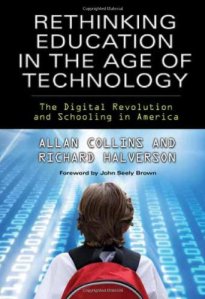
Rethinking Education in the Age of Technology, by Allan Collins and Richard Halverson
I’m preparing for a parent presentation on video games, learning, and kids. It’s a subject I’ve wanted to bring to a parent meeting for a number of years, and I’m excited to finally have it scheduled on the calendar.
Here’s my basic outline:
- Inoculate – basically address some of the common objections outright and diffuse potential defensiveness
- Reframe the discussion of video games: why do kids like them? (spoiler: it’s not because they are easy)
- What can games teach us about learning? (Overview of the research and history of games in learning and flow)
- Discuss common ways we denigrate or undervalue gaming, many times without even realizing it
I’m hoping to weave in lots of examples from Minecraftedu and SimCity, since those are the two video games we currently use in our curriculum. (Although it could be argued both of these are not the typical video games people think of. Minecraft is really more of a sandbox/creative tool and SimCity is an open-ended simulation tool.)
Stay tuned for a post of resources for my presentation!
I’m taking this opportunity to return to a book I read last spring, Rethinking Education in the Age of Technology, by Allan Collins and Richard Halverson. Just as with It’s Complicated, I’ll include some quotes, but know that the items that I pulled out specifically relate to my presentation on video games and don’t represent the entirety of the book.
- My biggest picture observation is that we are in a time of enormous change in the structure of education, and educators have little control of this, which is probably why things are actually changing. Educators are conservative in their practice because of the design of the system. Change is upon us, whether it’s the internet, the computers, the nature of globalization and global problems, or the homeschool communities. I think this is exciting!
- Watch a kid do math problems for homework. Watch a kid play a video game. When we know they are learning through the video game, why do we still feel in our gut that the math problems are more valuable? How did the popular culture and media so convince us into the idea that school and learning must be serious in order to be effective?
Notes from the book:
p. 9: 2 key arguments by technology enthusiasts:
1. “the world is changing and we will need to adapt schooling to prepare students for the changing world they are entering.
2. “technology gives us enhanced capabilities for educating learners, and … schools should embrace these capabilities to reshape education.”
Continue reading ““The Gamers of Today May Be the Leaders of Tomorrow””




 Julie Kallio, PhD
You must be logged in to post a comment.