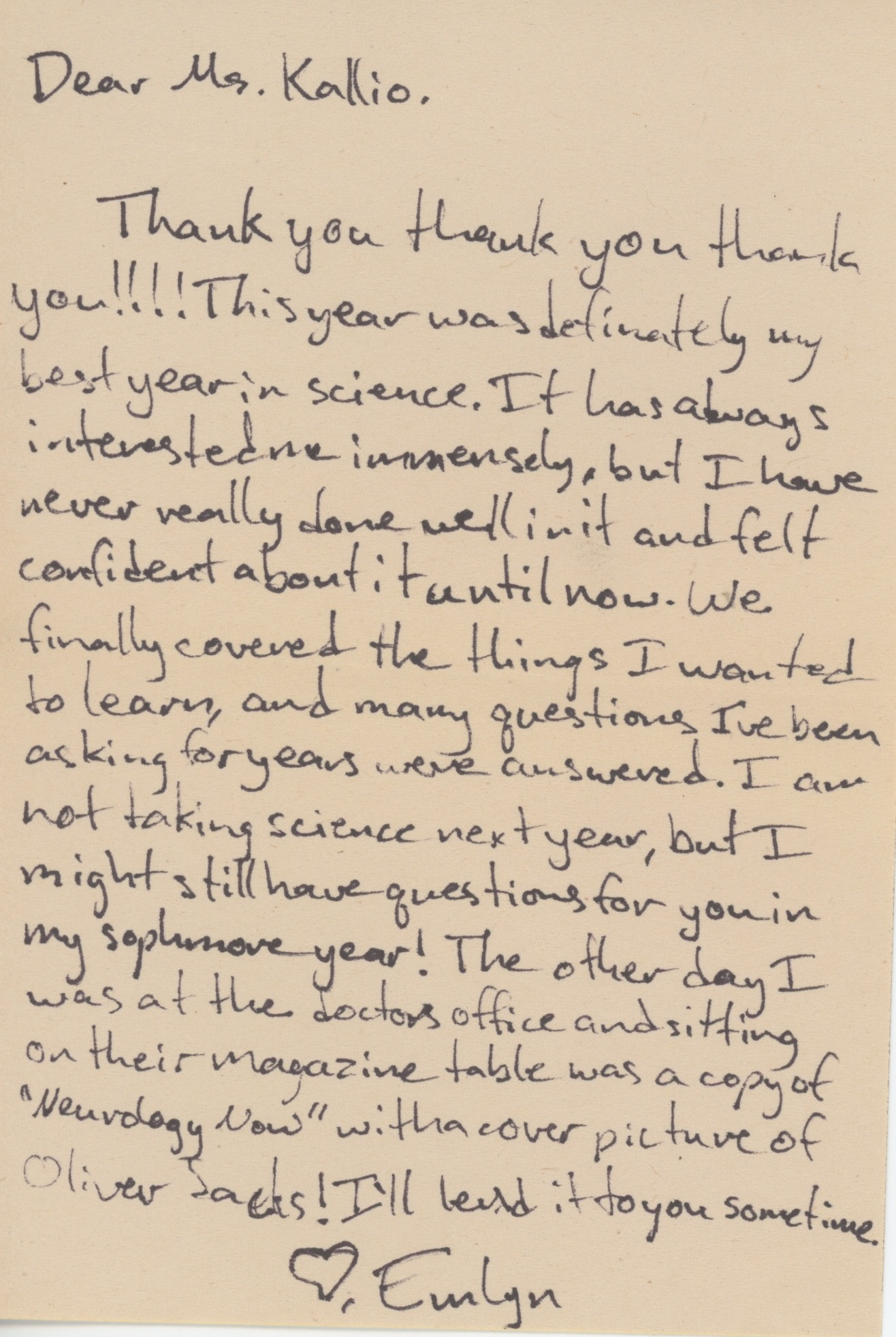
(My maiden name was Kallio.) I found this note from a former student while cleaning out an old box this summer. I remember my mom having a “warm fuzzy” file with things like this. It’s notes like this that make me feel like I really am making a difference in other peoples lives.
Blog
Fall is here, ring the bell
OES Bell Tower, Flikr photo credit to Day Tooley
Fall is here, hear the yell
This song by The White Stripes has become a tradition to sing at our first middle school gathering. I got a little choked up singing with everyone on Wednesday, counting my blessings to be part of this community. Although I’ve really been back at work for the last few weeks, it didn’t truly begin until this. Honestly, it feels more like a family reunion than going to work.
Our head of school began last Tuesday with an address to the entire faculty and staff. She referred back to her charge last June to be open to change and wove it into a story about Taliesin House, built by Frank Lloyd Wright. As she describes it, Taliesin is beautiful from a distance, with horizontal and vertical lines that nestle it into the hillside, yet as you get closer, you see that every space in the house is under constant redesign. This makes the building itself feel alive with change as the designers perpetually seek improvement. The metaphor was perfect, even if obvious, in capturing the essence of the constant growth that should take place in a school. While striving for vertical and horizontal coordination, we should all be fundamentally engaged in improving in our individual practice. Furthermore, this metaphor gives us the twofold direction she has chartered for this year: (1) coherent school identity, facilities, and program and (2) curriculum changes to align with PreK-12 curriculum and the Essential Competencies and support system upgrades. Continue reading “Fall is here, ring the bell”
Responsible Use Agreement & Laptop Care and Maintenance Video
We did laptop distribution today and I worked hard to streamline the process this year. I was the first to greet people and have them change their active directory password. Next they picked up their laptop, case, and charger, and headed for one of the two classrooms we had running. The idea was to have it work like a museum: once there were enough people in the classroom, they would close the door and start the video. Students had to change the password on their laptop and for their google account, watch the video, and fill out a checkout form.
I wanted to ease the stress of running the classroom by not having someone have to give the responsible use spiel over and over, so I made this video: RUA & Maintenance and Care of your Laptop.
I got the idea to speed it up because it was just taking too long to listen to the whole thing, and I like the feature of podcasts that you can make them go faster or slower. It turns out, however, that with iMovie ’09 there is a glitch that causes the audio to not export. So after a few days of feeling frustrated that it wasn’t going to work, I found a forum thread suggesting I detach the audio from the clip. I did it and Voila! It worked. Overall it was well received.
Article Review: “Education as Design for Learning”
This fall I am working on a personal statement to articulate my core values and beliefs in education. In my research, I found “Education as Design for Learning,” an article by Richard Halverson and Erica Rosenfeld Halverson.
Perhaps this is an obvious statement, but I find that having the words to describe what you are thinking or observing is necessary for thinking critically about it. When I am learning something, I need the big picture to hang the details on. Then, as I read, I can square my experience, understanding, and prior knowledge against the framework. Continue reading “Article Review: “Education as Design for Learning””
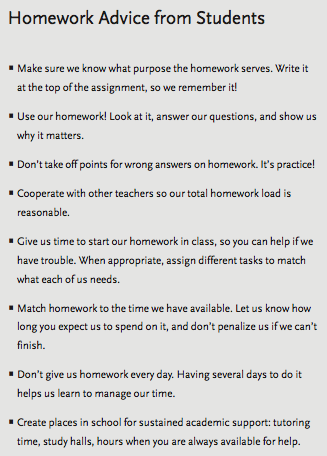
Homework Advice from Students
Book Review: Sticks and Stones, by Emily Bazelon
Side note: I used Evernote on my phone to take notes while I read. Because I was traveling and rarely reading in the same place, my phone was something always close by. I was able to type in quotes when I wanted or take pictures of paragraphs. I would love to see our students take advantage of this kind of resource gathering or curating.
Our critical friends group decided to read a book together this summer and put together a LONG list, but eventually we settled on Sticks and Stones, by Emily Bazelon. Since our group has teachers from PreK to Seniors, social/emotional dynamics came out as a common topic that applied to everyone.
I’m glad that I personally read it, rather than just listening to a summary or review on the radio. It was valuable to me to read the complicated stories of the three kids because it broke down the media sound bites that I remember. I think Bazelon does an excellent job of making it clear how complicated each tale is.
A few quotes that resonated with me:
- As I always suspected, Bazelon states earlier on, “The internet and the cell phone don’t cause bullying on their own … and they haven’t created a new breed of bullies.” (10)
- The FCD folks who come visit once per year have also talked about social norming, so this wasn’t new for me, but a good reminder nonetheless: “The idea is that students often overestimate how much other kids drink and drive, and when they find out that it’s less prevalent that they think – outlier behavior rather than the norm – they’re less likely to do it themselves….. Bullying, too, isn’t the norm…. when kids understand that concerted cruelty is the exception and not the rule, they respond: bullying drops, and students become more active about reporting it.” (13)
- “Teenagers, and even young kids, have to have their private spaces. It’s a tricky balance to strike, the line between protecting kids and policing them.” (13) Yes yes yes. And I will probably freak out about it when my son is a teenager too.
- I LOVE this: Delete day! Students held an event in the computer lab for people to come in and get help deleting unwanted social media tags, photos, posts, etc. and possibly even deleting accounts on websites such as Formspring. (290)
- “The research showed that news outlets frequently give no useful information about how to prevent bullying, even as they call it “epidemic” – false – and portray it as the biggest problem kids face today – also false.” (297) Can I make myself remember this next time a sensationalist story comes along?
- From researcher danah boyd: “the kids who live in places where physical roaming is more restricted who tend to socialize the most online.” (306) I’m most fascinated by this from a parenting point of view. Where do I need to live in order to provide space for my child to roam? This is more of a personal link, but I like the resources on Free Range Kids.
I used to be frustrated that schools were asked to “solve” bullying. “We all need to share the load – whereas at the moment, we’re mainly asking schools to shoulder it.” (16) But after reading this, I’ve come to the conclusion that schools are the only communal organization anymore that can reach most kids in a community, so it makes the most sense for schools to take the lead on this. Arguably, the first and foremost goal of schools is to help kids grow into healthy adults. Our mission at Oregon Episcopal School specifically states, “by inspiring intellectual, physical, social, emotional, artistic, and spiritual growth.”
This may be my number one takeaway: the importance of establishing a positive community for the healthy growth of all its members.
Bazelon comes back to this at the end where she states that developing “character and empathy” (305) are the most crucial things we can do as parents and teachers to proactively address bullying, not to mention improve student success (however you want to define success).
Overall, this book has been a positive affirmation of the independent international school where I grew up and the two independent schools where I have taught. These small communities, where each individual is known and cared for, provide the foundation for all other pursuits. I realize now how much I took that for granted in my first years of teaching as I focused almost exclusively on academics.
I appreciate the candor and humanness with which Bazelon approaches this subject, which is quite messy and emotionally loaded. One of my favorite phrases recently has been “the human condition,” when I’ve been faced with messy interpersonal relationships. Maybe it helps me feel like we are all in this together.
Scratch
It is a summer of making and connecting with SIGIS and the National Writing Project. I haven’t actually begun reading Invent to Learn yet, but I did find myself with a bit of time so I started working on my version of Frogger.
More to come!
Summertime playtime no-tech time
Signing off…
This summer my goal is to use Facebook less, carry my phone less, turn the radio off in the house and in the car in order to disconnect from work and be present with myself and my family. As I’ve written about before, I think I generally find a pretty good balance with my technology, but recently I’ve felt that when I see my devices, I feel like there is something that I’m supposed to be doing. I am notoriously unable to sit still as it is, but now that I am spending a lot of my day monitoring the little one, I have a constant ticker in the back of my head listing the chores, errands, and projects I should be doing.
What I AM going to do, is
- Walk with my dogs early in the morning
- Play in the dirt
- Swim, Bike
- Travel to see family
- Spend time at OMSI and splash pads
- Watch Downton Abbey with my husband
- Eat coconut ice cream
- Relish not being pregnant
I also have a long list of summer reading books, but the three that must be read are:
- Brain Rules, by John Medina – I’m offering this to the 8th grade for summer reading
- Invent to Learn: Making, Tinkering, and Engineering in the Classroom, By Sylvia Libow Martinez and Gary Stager – I’m reading this with SIGIS and our tech and science departments
- Sticks and Stones, by Emily Bazelon – Our critical friends group is reading it together and will have a book clubby type meeting in August
And what better way to end the year by looking forward to next! It is deeply satisfying for me to look back through my goals for this year and take stock of what I’ve done and where I want to go. An end and beginning together.
My goals for next year:
1. Gaming and programming
- SimCity – possibly connecting with another school, involving history and math
- Scratch – boosting the 6th science project
- 3DGameLab potentially in 6th library/tech
- Find a curricular place for MinecraftEdu
- Start after school club or group to work on game design and/or programming – maybe find a Girl Scout Troop?
2. Digital footprints
- Continue my own blogging, create a visual resume in Illustrator, and finish my “engaging beyond” page
- Start working with other teachers on the development of their portfolios and digital footprints linked to the Essential Competencies
3. Continue to seek balance amongst family, work, dorm, other professional commitments, exercise, and personal time.
HAPPY SUMMER!
Final #ISTE13 Post: Connect and Reflect
ISTE seems a world away now that summer vacation is here and my days are filled with story hour, diapers, ear infections, and naptime (or lack thereof). But I would be remiss not to reflect on yet another great conference on connecting with my current colleagues, fellow SIGISers, and new educators.
This list really isn’t in order of importance:
1. I’ve been using the SuperBetter app for a week now and dig it. I look forward to pressing the “I DID THIS” button and getting the happy ding of the achievements. I’ve even set up some of my own Power-Ups and Quests but I haven’t recruited any allies yet. I’m not sure how I’ll measure the long term changes in my behavior, but I’m enjoying the process for now. I’m hoping to pass this on to our support staff as a potential option for struggling students.
2. From the second keynote: I love Steven Johnson’s remixed quote, “Chance favors the connected mind.” I love the idea of getting out of your silo, connecting with others, drinking coffee, fueling creativity by stepping outside your comfort zone. That said, I have two thoughts:
- What about the quiet, mindful, reflective, independent time? I think this is needed in the balance and some people need it more than others. After reading Quiet last summer and identifying myself as an introvert, I guard “me time” as important in my own creativity. Is this another “everything in moderation” type deal?
- I’m curious about how the zone of proximal development applies to this idea of connecting with people out of your silo. I would think that the cafes of the 1800s were fairly local and culturally homogenous. When we mix in diverse groups, what happens if we’re too different? Does this break down the connections? Hmmm. I don’t have an answer for this. I’m really looking forward to my first day of Intercultural Competency training this August.
3. If I attend ISTE next year, what would be the best format for me? This year I LOVED the keynotes and poster sessions, but I was disappointed by the sessions I attended. What is the value of me going to this conference, year after year? I was thinking that what I would get the most benefit from is four days of concentrated work on an issue at school or a new project. Could I work on that in Portland? Yes, but I wouldn’t have access to the people that I have at ISTE. So maybe it would be a four-day informal get together (i.e. not paid) where a group gets together, and we learn how to build apps or design professional development portfolios or design a parent education series. This could leverage the power of the ISTE community and give me the space and time to work on a project for my school. ISTE14 is a long way off… but it could be fun!
4. I’m really excited about the summer of making, sponsored by SIGIS and SIGCT. I’m worried most of my “making” will be from 7pm-midnight after the little one goes to sleep, so I hope I can find the energy for it. My goal is to delve deeper into Scratch, take the 3DGameLab course on how to create an iOS App, and print something on the 3D Printer. Okay, I’ll be happy if I do ONE of these!
5. Last, my goals for ISTE13 were:
- Be where I am. Done. I feel good about this one.
- Gaming. 3DGameLab, SimCity. I feel good about this one too.
- Support. Not sure I got enough of this, but it will come out over the summer. I know some people’s brains were so full by the end they couldn’t process. Sounds like a follow up meeting in August would be good.
- Reflect. Once this is posted, done!
Now I should really go open that free Surface still sitting in the box…
Poster Presentation #iste13
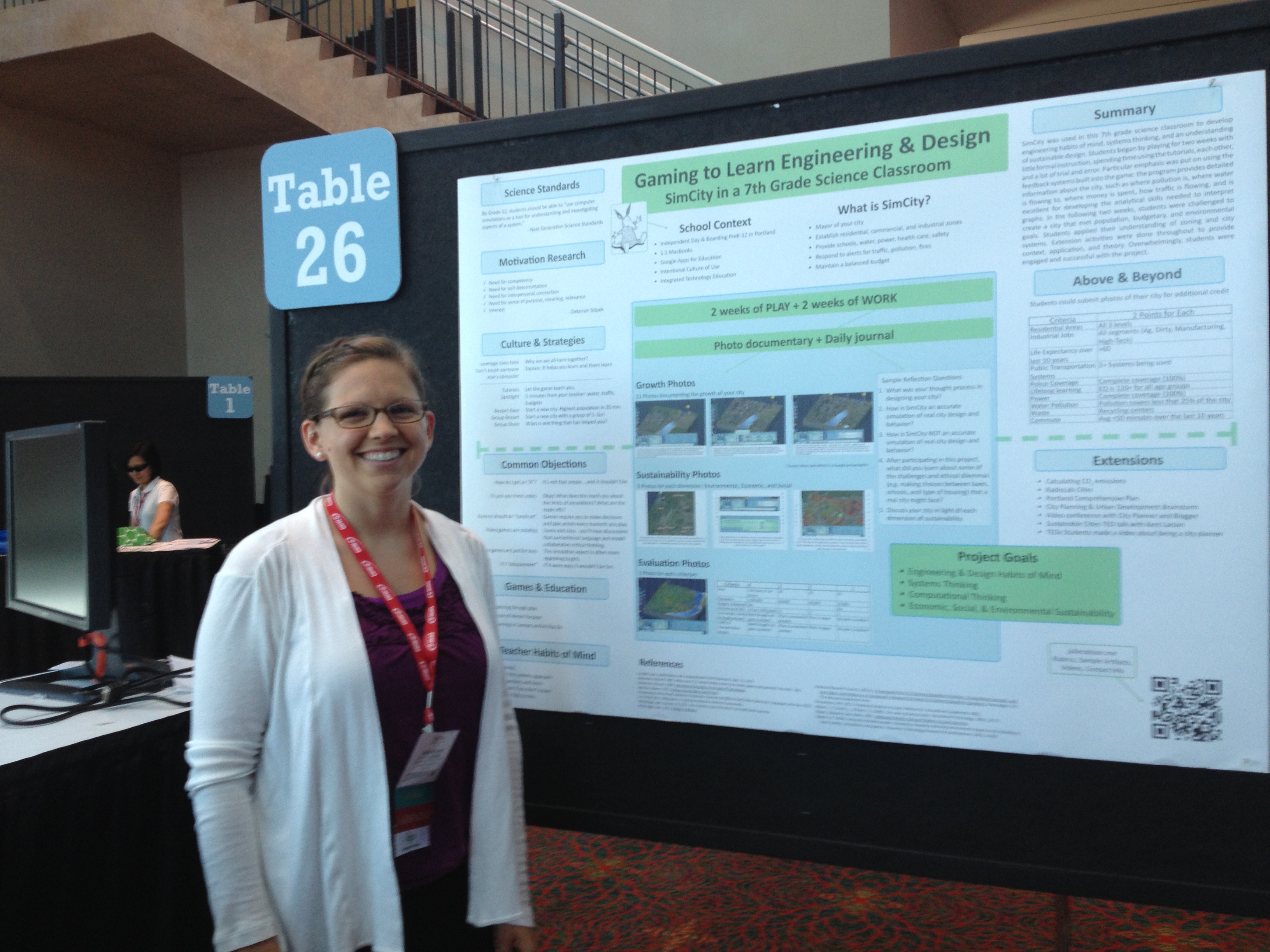
Yesterday evening I presented my SimCity project here at ISTE 2013. (You can find all the info on the conference resources page – please feel free to remix and reuse!) It was definitely a highlight of this conference for me, not just because I got to talk about my favorite work that I’m doing but because of the connections I made with other teachers and tech coordinators.
There are two connections that I’m really excited about though they are very different. The first connection is with two teachers from Phnom Penh, Cambodia, who teach at a small boarding school for Cambodian students. It would be fascinating for our 7th graders to video conference with them to discuss the ideas of urban planning and design. What interesting perspectives they would have on city development and infrastructure!
The second connection is with a teacher from Quest2Learn, the gaming public school (OOPS! – I initially posted that it was a charter) in NYC, and his referral to SimCityEDU. I thought it was just a forum for teachers to post lesson plans, but it sounds like the Institute of Play is actually taking SimCity5 and modding it to provide scenarios that teachers can modify for their classes. It might then offer feedback to the student and teacher about how they are interacting with the system. This means that I could see evidence of systems and design thinking rather than just believing that this project is effective.
Presenting my poster also affirmed the value of having other perspectives on your work. One visitor said that he no longer uses the word work in his classroom, but calls it purposeful play. It sounds like a small, semantic difference, but I do believe words matter.
I think the poster sessions are the hidden treasures of the conference because you get to see all kinds of different projects in different phases of development and you get to talk to the people doing them. As a pragmatic person, I appreciate seeing lesson plans and rubrics because I’m always thinking about the literal how-to of a project.
Speaking of pragmatic, next time I present a poster I will remember to bring my own video adaptor and push pins!


You must be logged in to post a comment.