Blog

Book Notes & Thoughts: Educating Activist Allies

swalwell

“There’s something sticky about privileged people studying injustice while participating in institutions garner the more advantage.”

How you teach and where you teach can powerfully undermine or reinforce what you teach.”

As part of my Ideology & Curriculum course this spring, I read this book by Katy Swalwell. The following is a version of the reflection that I wrote for the course, plus my reading notes afterwards.

While other books this semester were difficult to read in the sense that I had little previous experience with the material, this book was like reading about my own schooling and teaching experience. I was a teacher who was indifferent to “diversity” initiatives at first, then slowly intrigued, now actively engaged. For me, it was as part of teacher professional development that I came to reflect on and challenge my understandings of race and privilege. For this reason, it was odd to read this book as I felt like I was both the student and the teacher at Kent Academy. The analysis that Swalwell presents was educational for me both in my understanding of myself and of social justice education with privileged students.

“If we are to interrupt the reproduction of an equal opportunities and outcomes, we must understand how poverty is not just about poor people but about the relationship between people of all classes” (p.12). This quote has two aspects that I thought connected to our class: finding opportunities for interruption (linking to Educating the “Right” Way) and the structural approach of binaries (Bernstein). In other words, you cannot understand poor people without also examining non-poor. Continue reading “Book Notes & Thoughts: Educating Activist Allies”

Book Notes & Thoughts: The Shopping Mall High School, by Powell, Farrar, and Cohen

shopping mall high school

The semester is over, which means it’s time for reading! The summer around here is actually much busier than the semester, like trying to squeeze all the loose ends into the “free time” when you don’t have classes (oh wait, taking one class).

I’m really excited to geek out this summer about organizational theory. Seriously. I think I’ve gone from my first year “everything is novel and interesting” to my second year “I know what I’m not interested in anymore” and “I want to spend all of my time thinking about…” My advisor is stacking up the books for me to read, and my post today is from the first of those readings.

(As always, these thoughts are rough, non-linear, and littered with more questions than answers. I will say, though, that I have referred to these blog posts often as a way to remember what particular books or articles were about. This continues to be my commonplace book in the commons.)

The Shopping Mall High School: Winners and Losers in the Educational Marketplace was written in 1985 as part of a national study of high schools and is the second book in the series. In the introduction, the authors explain the analogy of the shopping mall:

  1. High schools accommodate the range of student needs by offering many options so they can achieve the result they want; there is “something for everybody” (p.2). There are four types of curricula: horizontal (different disciplines), vertical (levels of difficulty), extra-curricular (sports and other nonacademics), and social services (e.g. counseling).
  2. It is for students/families to choose their path, and thus not the school’s responsibility. Schools do not tell kids what to do. If they are happy, they will stay. If they stay, they will graduate.

The authors call these “treaties,” i.e. the compromises made to reach passing grades. “Learning is not discounted or unvalued, but it is profoundly voluntary” (p.4).

David Cohen wrote chapter 5, Origins, focusing on a history of the high school in two periods, 1890 to pre-WWII and the 50s to the 80s.Before starting graduate school, I read Kaestle’s Pillars of the Republic, which was 1790-1860, so this chapter almost picked up right where that left off.

The big debates were between 1) intellectual rigor and the perceived lack of ability by the masses of students enrolling, and 2) whether the curriculum should be academic or practical.

  • “Between them, Elliot and Hall had politely laid out the greatest issue that divided American educators at the time: could all students be expected to pursue an intellectually demanding program of academic study, or should most be given an easier and more practical curriculum? This question was full of implications for schools and for political democracy, but it was quickly settled – in Hall’s favor” (for the practical curriculum) (p.243), and by the 1930s this was in place.
  • “American educators quickly built a system around the assumption that students didn’t have what it took to be serious about the great issues of human life, and that even if they had the wit, they had neither the will nor the futures that would support heavy duty study” (p.244).
  • “Many educators argued that schools had to tie their work to new developments in American society: rapid industrialization, a knowledge explosion, and the efficient style of great corporations” (p.247)
  • “A new organization for high schools would help to turn educators into captains of industry and respected liters of society” (p.248).

Choice is something I’ve been interested in along with the research I’ve done on personalized learning. Many seem to think this is the first time we’ve given students choices, but not so:

  • “Student choice was an essential development in the new system. Reformers argue that students ought to be able to select their courses, and, within limits set by test scores and counselors’ opinions, to select the curriculum in which they would work” (p.258).
  • Choice was not a new idea, Harvard president Elliott had introduced an elective system, and Dewey had also urged educators to have a curriculum that got students interested. Dewey also worried about choices and curriculum, and argued against the “vocationalized and stratified offerings” (p.258-259) Dewey wanted to “marry quality and equality” and choice is not available to all students. Interestingly, it was actually students in the academic track who had less choice in terms of the number of academic courses relative to the vocational tracks.

Of key difference here, however, is that choice is used to keep students in school and to shift responsibility onto the student and the teacher.

I learned that it was not that schools or society wanted to educate everyone: it was a massive increase in enrollment as a result of the financial crises of the 1890s and lack of economic options for adolescents. They were in school because there was no work. So the schools compromised – gave them an easy path to graduation and tried to entice them to learn something along the way. From the beginning, it wasn’t about academics.

“So far, our picture of the high schools’ response to mass enrollment suggests a curious mixture of hope and despair. From one angle the reforms describe just above added up to a massive revision of educational substance and standards, all of it designed to cope with the deluge of students who were believed to be incapable of serious academic work. But the reforms were not an exercise and cynicism. There was 1 billion enthusiasm for the good work that schools would do with the new students. High schools would serve democracy by offering usable study so everyone, rather than dwelling on ab academic abstractions that would interest only a few. It was easy to ignore the great inequalities in what students would learn – for a booming economy needed clerks as much as it needed corporate executives. The reformers’ vision combined deep pessimism about most students is academic capacities with high optimism about schools is capacity to do good” (p.259-260).

“If most students were as incapable as reformers believed, how can we explain the reformers’ astonishing faith in the schools power to redeem them?” (p.260). This quote has interesting resonance with Can Education Change Society?, by Michael Apple, which we read at the end of our class this spring. Clearly we still grapple with whether schools are agentic institutions.

Cohen’s perspective on this: “The answer lies, first, and the simple fact that the reformers were pedagogues…. Second, these educators had been raised in the faith of Horace Mann. Most were small town men, drawn from the protestant heart of the country, where a belief in education’s saving power had deep religious as well as political roots. If education is America’s civic religion these men were among its leading evangelists, struggling to build institutions that would bring the untutored masses into the one true church. Faith of their sort is rarely diminished by evidence about the heathens incapacity; if anything such evidence only heightens evangelical zeal” (p.260).

One of the consequences of these treaties was that if students were not engaged, it was the school’s fault or the curriculum’s fault because it wasn’t engaging the students.

Also very interesting, was the “invention” of adolescence (p.262) by Joseph Kett. Russell and Hall describe adolescence as “the best things are springing up from the human soul” – endless enthusiasm. “If the race is over to advance, it will not be by increasing longevity… But by prolonging [adolescence]” – Hall (p.262). As a former middle school teacher, I agree!

All this talk about “practical curricula” is that it sounds basically like project-based curriculum, which either means it’s incredibly hard to implement or it’s not actually the best way for schools to do this, if they were talking about it in the 20s and 30s and we still can’t seem to do it today hundred years later.

  • “It seems, then, that the reforms discussed here produced the worst of both worlds: new courses, content, and academic standards that were less intellectual and more practical, and a style of teaching that was as dull as reformers had once complained of in Latin and medieval history courses. There was one difference, though: it was much easier for students to get through. Schools could best be more successful, at least in the sense of increasing both enrollment and graduation rates” (p.267).
  • “The practice of passing students through the grades on the basis of age and attendance, rather than academic achievement, soon came to be known as social promotion. That was the final, crucial stone in the foundation of math secondary education, for it meant that progress in school was detached from progress in learning” (p.267-268)
  • “The practical curriculum for every day living that he wanted ‘would give both better mental and better social training to perspective college students and they are getting now.’ [statement by Prosser, Harvard president] There really was a perverse populist slant to this educational Babbittry, a democracy of anti-intellectualism” (p.275).

I found this quote fascinating for it’s commentary about “American” life.

  • “After all education is one of our oldest enthusiasms and vast enterprises another. the combination was bound to please. another reason that so many Americans found high schools to their liking was that the institution tied up many contrary threads in the country’s character: great faith in the good work that schools could do but little confidence in most students’ academic interest or ability; Great faith in the transforming power of curriculum but modest budgets, and thus teacher workloads that would defeat most efforts to make classrooms exciting or challenging; great faith in the Democratic extension of schooling to all but an anti- intellectualism that severely limited educational content for most; great faith in the schools potential for equality, but a school organization that created terrific inequalities. These stunning polarities were the fundamental terms of reference for high schools – the treaties, if one likes, that Americans made in order to extend secondary school to all comers. Educators had managed to build a system of secondary schools in which the popular passion for education and popular contempt for intellectual work were woven tightly together.”

Moving on to the 50s-80s…

  • The reforms of the 1950s – denunciation of academic weaknesses, focus on science and math, attack on the Life Adjustment Education that had begun in the 1930s. (p.281)
  • Also in the 1950s huge increase in the number of students attending college. Ironic though that the more that attended they were being admitted to less selective institutions, so there was less pressure on high schools to have rigorous college prep courses. (p.292)
  • Brown versus board in 1954 the movement for excellence soon became an even more intense movement for equality, and this had a counter effect of eroding the sense of schools as fair progressive and open.
  • There was a continued relaxation of course standards and requirements.

The fate of the 1950s reform is that it was vulnerable to forces beyond the control of schools or reformers – the “selective excellent strategy”(p.296-297) saw that it failed but it didn’t really succeed either:

  1. Rapidly changing national political agenda simply diverted attention from high school
  2. Educators responding to all reform efforts in the same fashion: diversify our offerings to accommodate the pressures for new constituencies, and continue to ease standards and invent interesting courses for the still expanding mass of students judged in capable of serious thought
  3. The 50s reformers did not challenge this tendency

“Here is one of the biggest bargains in the brief history of mass secondary education: intellectual quality would be acceptable to educationists and appealing to reformers as long as it was just another small item in that large cluster of accommodations called the comprehensive high school” (p.297)

This can be seen as terrible or admirable – on the one hand students may be have been short changed, but on the other schools are demanded of by so many different factions, without the resources to do it, that they are remarkably adaptive (p.297) 

In the 70s there was a sense that schools created a bad youth culture, so there was pressure to engage with the community and have students experience work – so there were lots of internship programs. “Even a reform that was aimed at reducing high schools dominion over youth was turned to institutional advantage. The notion that experience should replace cooling became the rationale for adding yet another division to the schools curriculum.” (p.298)

“The reforms aim to improve education by ratcheting up school requirements, yet a large fraction of the students now in high school seem quite immune to such requirements. The students are educationally purposeless. They attend for reasons quite unrelated to learning … opinion surveys show repeatedly that most students, like most adults, do not regard academic work as the primary purpose of schools: they give greater importance to social and vocational matters into personal development. And whatever the reasons for being in school, students are frequently hostage to circumstances that tend to defeat learning … Perhaps high schools teach students what they need most to know: how to endure boredom without protest” (p.303).

“Secondary educators have tried to solve the problem of competing purposes by excepting all of them, and by building an institution that would accommodate the result” (p.306).

As I was reading I kept wondering what my dad’s high school in the 50s was like or my mom’s high school in the 60s. Or my grandma’s in rural Upper Peninsula of Michigan in the late 1930s. Who were their teachers? What did they learn? What did they think of all the curricula or was it just about going to school and socializing?

Carnegie Summit 2016 Reflections: Improvement Science for Social Justice?

The first Carnegie paper I read was Getting Ideas into Action (2011). This led to reading on the Carnegie website, reading Organizing Schools for Improvement and Learning to Improve, eventually getting into Engelbart’s original address to Bootstrap, and attending the Carnegie Summit in 2015… which is all to say that I did not come at this from a social justice perspective. I thought the networks were cool and the results were compelling. But as I was sitting in the closing keynote by Marshall Ganz, surrounded by an audience of mostly white people concerned with practical measurements and driver diagrams, I thought to myself, “Why is a civil rights community organizer giving the closing keynote at this summit?”

Over the past year, I’ve taken two classes which have dramatically shifted my graduate school path: Legal Issues of School Choice with Julie Mead and Ideology and Curriculum with Michael Apple. Both have challenged me to ask questions about power, equity, justice, and race as it relates to the public educational system. Though my awareness of white privilege and race traces back to the Klingenstein Summer Institute and the Intercultural Competencies work as OES, a year ago I still saw it as something auxiliary to my core work. Now, while I may not convert to being a critical theorist, my view of the world has been challenged and perhaps reoriented to more complex understanding of the systems we live and act within.

This year, the theme of social justice was even stronger:

  • A quote from Kim Gomez (which I saw on Twitter): “It is a social justice issue to teach with curriculum that doesn’t give all students access.”
  • Keynote speaker, Hahrie Han: building the power for change is about engaging people that recognizes their humanity; instantiate networks that recognizes our humanity and keeps the child at the center; peace and justice are a struggle
  • Louis Gomez introduced the final keynote with the line, “The quest for equity takes many paths.”
  • Closing Keynote speaker, Bryan Stevenson: Get proximate with the people who are excluded, change the narratives that sustain the problems, stay hopeful, be willing to do uncomfortable things.

This has all led me to be skeptical of improvement science and its promises. Is it an interruption or perpetuation?


Starting a NIC: Resource Round-Up

Plant-Growing-Nature-Picture-Hd-Wallpaper-Background

One of my goals for attending the Summit this year (that I wrote about last week) was to bring back an understanding of starting a NIC. What I’d like to do here is compile my notes, link resources, and highlight key ideas from the sessions. I’ve attempted to categorize them roughly into foundational/big ideas, what to do first, and then later considerations.

Foundational/Big Ideas

1. Formation of the network initiation team

  • Develop a theory of practice improvement
  • Understand the problem of practice – be there to observe, user-centered – take the test! What actually touches students as they learn?
  • Decide on a common and measurable aim (craft aim statement, more detail below)
  • Specify high leverage drivers (root cause analysis tools)
  • Attend to power relations (particularly supervisor/evaluative relationships) and other contextual politics
  • Do we have people from outside education?
  • Learning to use improvement research methods: the NIC team needs to support each other in building common practices. everyone gets the book!
  • Get an office staff person – someone to book rooms, schedule site visits, manage calendars, order coffee… this is a key role.

2. Focus on the Problem, or face “solution-itis.” Resource: Carnegie blog post

  • Solution-itis = get more enamored of a particular approach or philosophy with an unclear way that this will address the problem
  • The problem is the “anchor”
  • Not all questions are worthy of inquiry! (Ex. Having students turn homework in on time is not a meaningful problem to work on.
  • What is the unit of analysis? Okay to have it be one teacher’s classroom.

3. Crafting a “Network narrative”

  • Metro-map activity – help people talk about how they got here
  • Narrative as a way to mobilize people for the work (it’s not always just about the problem)
  • Networks are about influence, not control: Who we are and why we exist must be compelling

4. Thinking about Meetings

  • Improvement science as a social practice (Tony Bryk, opening keynote) – the meetings are where the network is instantiated
  • Meeting in person at first (commonly a multi-day summer institute) gives people opportunities to connect, around more than just the focus of the work – give people money to go out to dinner in inter-organizational groups
  • Schedule regular times, like weekly google hangouts
  • Use meeting protocols – this prevents one person from always speaking for a group or those traditionally empowered from dominating/controlling the conversation
  • Provide actuation spaces. We generally do not have problems that can be solved by more information. People need time and space to make sense together.

5. Building a Measurement System for Improvement

  • Evaluate short term needs, long term goals
  • Measurement is attached to the change process
  • Noncognitive measures resource from the Chicago Consortium on School Research
  • Traditional research methods (video/audio recording + coding) vs. 5 minute survey
  • Limit the amount of data

6. Role of the content expert

  • Bring in information to guide action once the problem is defined, ex. bring in literature
  • Balance between research, capacity building, and implementation
  • Role is different – need to provide opportunity where experts want to get involved (i.e. they get something out of it) but where they get on board with the direction it’s going and not just where they want it to go

7. Role of the network hub

  • Everyone needs to learn to use improvement research methods, but it’s the role of the network hub will be to support network members
  • Lots of strands running
  • Do the analytic work
  • Attend to social motivation

8. Leadership thoughts

  • You invent the work as you do it – being open about the complexity
  • A paradoxical mindset – engage with opposing interpretations, suspend judgement
  • Be eclectic about methods
  • Attend to both social pieces (facilitating a meeting) and technical pieces (cycles, due dates, action steps)
  • “Definitely incomplete and possibly wrong” mantra
  • This is the ANTITHESIS of strategic planning!

What to do first

Get into the schools!

  • Bias towards action. Get out and do something. Anything that gets done is going to be incomplete and partially wrong, so get started.
  • Test something – hunches, theories, ideas. Scale comes later.
  • This test might just be with one classroom – have initiation team be there

While you’re there,

  • Listen. This is a social practice. It’s about people and relationships first.
  • Listen to students!
  • Ask questions to understand the problem of practice

Research has to be rapid: 90 day cycles

  • First 30 days – be user-centered
  • Next 30 days – what does the literature say? Pareto 80/20 principle. focus on good theory with empirical warrant.
  • Last 30 days – PDSA begins – small interventions. where did it work, for whom, and under what circumstances? Report out

Later considerations

Build structures for local ownership

  • The role of the network hub may change over time. Think about a gradual transfer of leadership – building the agenda may be housed at the university at first, but eventually want to transfer this to the school.
  • Sometimes, get out of the way and let teams do their work

Build cross-team connections

  • make the network visible, reiterate the aim statement
  • find a common language, be sensitive to and aware of local politics
  • develop team norms, ex. assume everyone is doing the best they can
  • measure network health, ex. social network analysis – quick survey after every meeting with simple list of people asking who they have interacted with and how – trackable over time

Build “intervention bundles”

  • Everyone tried different things… what shows promise? How can these be combined?

Other resources

R+P Collaboratory webinar series – I have to go back and watch these! They cover topics such as “getting a partnership started” to “negotiating roles”.

Obviously, the Carnegie blog has a ton of resources, but they specifically have a series on starting a NIC. The first one by Jennifer Lin Russell  offers a framework and cool diagram. Also coming soon in article format: Russell, Bryk, Dolle, Gomez, LeMahieu, Grunow – A framework for initiation of NICs, Teachers College Record (in press)

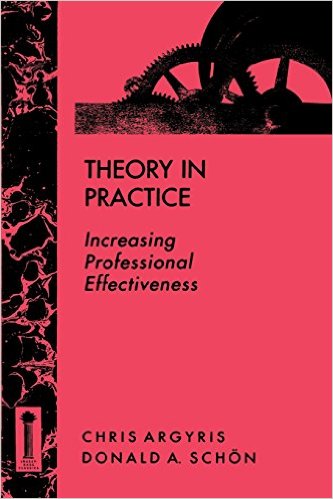
Book Notes & Thoughts: Theory in Practice, by Argyris and Schön (1974)

theory in practice

Why do we do what we do?

In a model where humans are taken to be rational actors, we each have a “theory-in-use,” an internally consistent logic, that guides our actions. Theory of action is about what we believe we should do to effect a particular action. For example, in situation S, if I want C, I do A, given assumptions a1…an. To characterize someone’s theory of action, however, you cannot just ask them: you must observe what they do because their espoused theory may not match what their theory-in-use. Though if the two are the same, this is a state of “congruence” (p.23).

What good is all this?

First, embedded in all this is a theory of learning: by formulating our theory-in-use, we can change it. This change is the learning. The goal of describing is to “produce data that help the individual learn” (p.38-39). This reflects a cognitivist approach: having people articulate their behavior, understand it, then their theory-in-use will change as a result.

Second, making theories in use explicit allows practitioners to share their practices. Argyris and Schön speak at length about the problems with professional education (p.14) and their mismatch between professional education and post-graduation institutional arrangements. This is definitely true in education.

Argyris and Schön contrast the difference between traditional scientific research and practice-based professions. In science, scientists communicate theories, methods, and results with each other so that others will test them to build knowledge. Knowledge is public, explicit, and cumulative. Everyone contributes to this knowledge, pushing us all forward. In the professions, knowledge is practice-based, and the learning is private, tacit, and ephemeral (p.144). Articulating theories-in-use, or making the tacit explicit, becomes a way of building knowledge of practice that all can test.

Argyris and Schön trace the history of professions: how the disciplines split from the church and then again when they split between liberalized and rationalized. Aside from being interesting history, it traces the rise of professional expertise in applied fields. This connects to my interest to understand how research and development works in education. In the industrial age, research and development came about as a place where knowledge was converted from a production environment to an engineering environment. What is the parallel in education? How do we “convert” the production of new knowledge from inquiry to changing practices in action?

This week I was at my second at the Carnegie Summit in San Francisco. Their Networked Improvement Community model is meant to be a “social reorganization of research and development” in education. It is in this space where knowledge is converted from “pure” inquiries to action. I’ve been working to understand what “educational R&D” really meant, but I think I understand that it is a shift in how knowledge is produced and used. Rather than it being a technical process where contextless knowledge flows (via journal articles?) from research to practice, NICs are a social infrastructure where people work together to define problems, articulate how their actions will change the result, bring resources to bear on the actions, and then implement it iteratively in context. In situation S, if I want C, I do A.

Sometimes I wonder why particular books make it into my hands at particular times and I get motivated to read them despite a myriad of other things I *should* be doing. This was one that somehow felt right to read right now, and lo and behold the connection it helped me build.

Carnegie Summit 2016: Pre-Conference

Kallio_Carnegie_Poster

Here I am, my second year attending the Carnegie Foundation Summit on Improvement in Education! I’m presenting a poster of my research: A Cross-Case Analysis of Three Networked Approaches to Educational Change.

Every time I attend a conference, I try to write out my goals for attending or questions I have. I try to do this before the conference, but this year it’s happening on day two.

My experience with the conference this year is a bit different because over the past year I’ve immersed myself in the work of Improvement Science and Networked Improvement Communities, Design-Based Implementation Research, and the Theory of Action of the Institute for Personalized Learning (see poster above).

My focus this year will be to look for strategies for starting a Networked Improvement Community. I’m also keeping my ears open for opportunities for my own research inquiry/dissertation. To do this, I’m looking for what people talk about, how people talk about it, what people don’t understand or struggle with, and contradictions in what people say. One of the most interesting threads is Improvement Science and NICs for social justice. I wonder how critical theorists might think about this work.

Sessions I’m interested in attending:

  • Launching a NIC
  • Crafting the narrative of your NIC
  • Building a measurement system for improvement
  • Network Development Evaluation (meta-analysis of the network)
  • Understanding the Problem you are trying to solve: Causal system analysis OR Leveraging content expertise to build change packages in networks

Keynotes:

  • Tony Bryk – Narrative of the Pathways program
  • Alex ‘Sandy’ Pentland – digital media and data scientist
  • Hahrie Han – how organizations “engage, mobilize, and organize activists and leaders”
  • Bryan Stevenson – Equal Justice Initiative, author of Just Mercy

The second 500m

womens rowing pair
Olympic rowers – Women’s pair, as they finish a stroke.

I rowed crew my freshman year of college. In the fall, the races were longer distances and a waterfall start, so you rowed your own race and just listened to the coxswain, who did the thinking for you. In the spring, races were a 2000m sprint, and they were raced head to head. Mentally, you could break up these races into four 500m stretches. The first 500m was to get going – quarter, quarter, half, full – shorter strokes to get started. This burst of energy and intense concentration would carry you 500m before you realized it. In the second 500m, you needed to calm the adrenaline surge, settle into a pace, ease the anaerobic burn in your quads, and pull together. By the third 500m, you have a rhythm and are ready to really pull, and the last 500m is everything you’ve got to propel the boat as fast as you can. Then it’s over.

It’s the second 500m that was always the hardest for me. The adrenaline surge of the start had peaked and my mind would be jumping all over the place. My quads would burn and I’d want to quit. I remember struggling to manage my breath, which was coming shallow and fast from the jump start.

The highlight of rowing that year was winning the pair race at the SIRAs regatta. In a pair, there is are just two rowers, no coxswain. I was in front as stroke seat with my pair mate behind me. In the second 500m of that race, I had to set and settle into a stroke rhythm that wasn’t so fast we’d burn out but also not so slow we’d lose. There was no coxswain to listen to and offload the thinking, and I remember the responsibility that I felt as the stroke seat. It was up to me to calm my body and mind into a sustainable rhythm for myself and my partner.

The start to my fourth semester of graduate school feels akin to the second 500m. With three semesters behind me and the birth of our second child this fall, the first 500m jump start is behind me, and the adrenaline carried me through the end of last semester. Now I face settling into a sustainable rhythm that balances and focuses my efforts into my responsibilities as a parent and as a student.

I imagine a coxswain calling, hearing what she says as she feels the unsteady rocking of the boat. “Catch – Send!” This drops our oars into the water together for maximum efficiency, drawing the stroke through to the fullest. “Catch – Send!” This narrows our minds onto the task at hand, getting the last bit of pull off the oar. “Catch – Send!” This settles us into a rhythm to carry us on, because there is still a lot of race left to go. “Catch – Send!”

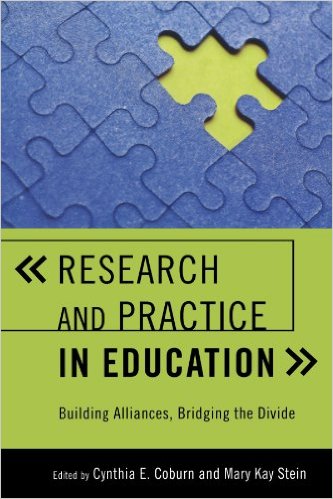
Book Notes & Thoughts: Research and Practice in Education, by Cynthia E. Coburn and Mary Kay Stein

researchandpracticebookcover

I have a new strategy for literature reviews, which is how I found this book. Basically I find the people whose ideas I’m interested in and then find everything they’ve written. This past summer, I read a white paper by Coburn, Penuel, and Geil (2013) called Research-Practice Partnerships: A strategy for leveraging research for educational improvement in school districts. Right up my alley. Loved it. So I went in search of what else the authors do and have done.

First, Bill Penuel is a research at UC-Boulder. During my design-based research class this fall I had to research and present a DBR project, so I used the opportunity to read about Penuel’s work with InquiryHub and learned about DBIR (design-based implementation research). Starting with the person gave me a window into the current research conversations rather than simply past published work.

Cynthia Coburn was another author on the article, so I went looking for her other publications and found this book of case studies. It is divided into four sections: university-school partnerships, tools, larger scale networks, and district-level partnerships.

The three chapters on the role of tools used concepts from some of my previous reading, such as Wenger’s Communities of Practice, which I wrote about here and here, or Star’s boundary objects, which I had read about in the DBIR work. Getting to see how these ideas are APPLIED and written about is critical, I think, in my development as a scholar.

Ikemoto and Honig write about the Institute for Learning and how an intermediary organization can partner with teachers to improve student learning. While IFL itself is interesting, what I learned most from this chapter was how to apply a sociocultural learning perspective to ground the analysis of their research. They specifically look at how tools of the program, such as IFL’s Principles of Learning or their LearningWalk protocol. Interestingly, I think there is a difference in what they refer to as tools and what some refer to as artifacts.

In the aforementioned DBR class this fall, I heard many times about LeTUS, and getting to read the meta-description and analysis of the project answered many of my questions about it, continuing to fill in my understanding of the research-practice landscape.

My favorite chapter was the one about a larger scale: the National Writing Project (NWP). Laura Stokes applies Englebart (1992)’s organizational levels of infrastructure to the theory of action of the NWP. This is the same conceptual framework that is used to describe Networked Improvement Communities work (Bryk, Gomez, and Grunow, 2011) and will inform my spring research project studying a regional network. If I hadn’t been reading every chapter, I would have missed this connection.

Stokes describes NWP as an “improvement infrastructure” and demonstrates how the design of the network acts at A, B, and C Levels to improve student and teacher writing. Stokes cites the key components of the infrastructure as its model, its linked local sites, its knowledge resources, its people and its programs. I like the visual they use to show the action levels of the Local NWP sites and NWP Network.

NWP_ActionLevels

The key here is that work that learning that happens at Level A accrues to the network, so individual pockets of teachers are not rediscovering what the teachers at the school next door already know. I like to think of the infrastructure as a harness that links us all together so that as some move forward we are all drawn along. Your work improves my work and vice versa.

Side note: I have always LOVED that NWP requires its participants to do their own writing, such as having teachers actually write out answers to the prompts of the college entrance test (p.154). One of my firm beliefs is that teachers must continue to engage in learning what they are trying to teach. This is one of the reasons I like working at Field Day Lab, where teachers learn through designing.

The chapter about Lesson Study by Perry and Lewis was excellent, especially given my participation in a Critical Friends Group. I think if I were to be in charge of professional development at a school or district this is how I would want to approach it. They note that “lesson study is about the lesson, not about the teacher” (p.133), which aligns with some of the other reading I’ve been doing about professional development as improving teaching, not teachers (Hiebert & Morris, 2012).

The conceptual frame of this chapter, increasing the “demand” for professional development, was interesting. I’m not always a fan of use economics terms outside of economics, but I understand their application of Elmore (1996)’s use of the term. Note to self, must look up Elmore’s work.

In their concluding chapter, Coburn and Stein reflect on the implications of the case studies presented. One is that “designers should place renewed attention on teacher learning and organizational change” (p.217), with attention to how teachers “learn how to teach”. They cite the designs needed to harness the work of practitioners: tools to foster interaction, participation structures, and intentional pathways to connect research and research-based ideas. (p.219) Notably, at the school level, teachers need opportunities to experiment with new approaches AND discuss and adjust practice. I think we often do the first but not the second, and meaningful discussions do not happen by themselves, which is why I love the critical friends protocol.

All of the projects described in this book are multiyear, well funded initiatives. I have two thoughts about this. First, when I think about my career, ultimately I would want to build one of these networks or partnerships.But where do I focus – tools? teachers? districts? teacher education? intermediary organizations? policy? Furthemore, what implications does this have for the role I conceive of as a researcher? How does this match with the traditional role of a university professor, and is this the best job to achieve what I want to do? As they note, traditional scholarship often creates disincentives to do this kind of work. (p.224)

Second, when I think about the more immediate demands of a dissertation, I won’t be able to build a practice-partnership likes these, so perhaps I can concentrate on finding interesting networks or partnerships already in progress and study them. I have some ideas…

Overall, this book builds on my consistent interest in how schools change, and, in these chapters, it is through partnerships with researchers or outside organizations. The most valuable takeaway for me from this book was the value of reading (or at least skimming) every chapter, which is why I continue to prioritize the time to read and then write about my reading.

PhD Year 2

the_days_are_long_but_the_years_are_short_poster-r1b409fd24b3b4b8b9817fd3fc805ac95_jnx_8byvr_324

I love the first day of classes: The anticipation of new ideas to explore, the possibilities of papers and projects, the expertly curated reading list (i.e. syllabus) handed out that will map the course through a new world.

But there is also doubt: Will I be able to understand these ideas? Will I complete these projects? Will I get the reading done and be able to speak articulately about it in class? Can I do this?

Then come the introductions: My name is… My program is… My advisor is… I’m from… I used to… and – the hardest one – I’m interested in…

As I start my second year as a PhD student, what I’m interested in researching/doing/becoming/contributing is much harder. This past year I had a pretty good answer – something about trying to understand how schools change – but it was so new, all about exploration and learning. I feel like I spent this past year backpedaling through paradigms and theories, trying to find an epistemological framework that resonates with me and a topic area that I’m passionate about and can actually study.

As my colleagues went back to work, the school year starting, I found myself longing for the predictable to do list of preparations to make for students arriving. I wanted that productive, task-oriented work where you know what you’ve accomplished. Maybe I could go back to that world?

My advisor said to me that starting your second year is when you look up and realize how far away you are from shore. I didn’t even realize that I’d been keeping tabs on the shore, the back up plan, my escape to safety – you know – in case this whole PhD/academia thing doesn’t work out.

But it will. Books will get read, papers will get written, projects will get finished. I’m sure this year will fly just as last year did, though hopefully I’m closer to identifying my interests at this time next year.

The days are long but the years are short. So I’ll tamp down the doubts and plan out my work and just keep swimming.

Book Notes & Thoughts: A New Literacies Sampler (2007)

a new literacies

Edited by Michele Knobel and Colin Lankshear, Free PDF here

Like reading Communities of Practice, this work is a foray into new perspectives for me – always interesting and usually completely disruptive to my current, constructed understanding of the world. I have read bits and pieces (and reflected here and Discourses here), but I wanted to read the entire compilation this summer. This reflection is after reading the first three chapters.

The works in this book are firmly in the constructivist paradigm and use a sociocultural perspective on literacy. This latter parts means that “reading and writing can only be understood in the contexts of social, cultural, political, economic, historical practices to which they are integral, of which they are a part.” (p.1) Understanding literacies in this way is the foundation of calling them “new.” It is more than just reading and writing (i.e. encoding and decoding print), but it is the “relationship between human practice and the production, distribution, exchange, refinement, negotiation and contestation of meanings.” (p.2) It is seeing the acts of reading and writing encompass norms, attitudes, values, meaning-making – all of which are as social practices. Continue reading “Book Notes & Thoughts: A New Literacies Sampler (2007)”